

Hiring the right people is one of the most important decisions any business can make. A strong candidate can bring new energy, better performance, fresh ideas, and long-term value to a company. But hiring without the right tools, clear information, and proper matching can quickly become stressful, time-consuming, and uncertain.
Modern recruitment is no longer only about receiving applications and choosing from a list of CVs. Employers need a smarter way to find the right talent, verify candidate quality, understand role alignment, and make confident hiring decisions. This is where Kingfisher Jobs helps businesses hire with more clarity, trust, and confidence.
With smart matching, verified profiles, skill assessment, job alerts, and career-focused insights, Kingfisher Jobs supports a better hiring experience for both employers and candidates. The goal is simple: connect the right people with the right opportunities and help businesses build stronger teams.
Why Hiring with Confidence Matters
Hiring is more than filling an empty position. Every hiring decision affects team performance, customer experience, company culture, productivity, and long-term growth. When a business hires the right person, the impact can be powerful. When the wrong person is hired, the cost can be high.
A poor hiring decision can lead to delays, lower productivity, repeated recruitment costs, training challenges, and team disruption. That is why employers need a hiring process that reduces uncertainty and improves candidate quality from the beginning.
Hiring with confidence means having the right information before making a decision. It means understanding the candidate’s skills, experience, reliability, and suitability for the role. It also means using a platform that helps employers find better matches instead of sorting through large numbers of unsuitable applications.
The Challenge of Finding the Right Talent
Many businesses face the same recruitment problem: they receive applications, but not always from the right candidates. Some applicants may not match the required skills. Others may not understand the role. Some may have experience, but not the right fit for the company’s needs.
This creates a time-consuming process for hiring teams. They must review applications, compare profiles, schedule interviews, and assess suitability while still managing their daily business responsibilities.
Common hiring challenges include:
- Too many irrelevant applications.
- Difficulty identifying the best-fit candidates quickly.
- Unclear candidate skill levels.
- Lack of verified profile information.
- Slow communication between candidates and employers.
- Uncertainty during shortlisting and interview decisions.
- Difficulty matching candidate strengths with role requirements.
These challenges make hiring feel complicated. A smarter recruitment platform helps simplify the process by improving visibility, matching, and confidence.
What Does “Hire with Confidence” Really Mean?
Hiring with confidence means making recruitment decisions based on better alignment, clearer candidate information, and stronger matching. It is not about guessing who might be suitable. It is about using the right tools to understand which candidates are more likely to succeed in the role.
A confident hiring process includes:
- Verified candidate and employer information.
- Clear role requirements.
- Skill-based matching.
- Relevant candidate profiles.
- Structured shortlisting.
- Better communication throughout the process.
- Hiring decisions supported by useful insights.
When these elements are in place, employers can move forward with less uncertainty and candidates can apply with more trust.
How Kingfisher Jobs Supports Better Hiring
Kingfisher Jobs is built to make hiring smarter, clearer, and more reliable. The platform supports employers by helping them find candidates who match the role more accurately, while also helping job seekers discover opportunities that fit their skills and career goals.
Instead of treating recruitment as a simple listing process, Kingfisher Jobs focuses on connection, trust, and relevance. This creates a better experience for everyone involved.
Smart Matching: Connecting the Right Candidates with the Right Roles
Smart matching is one of the most valuable parts of modern hiring. It helps employers identify candidates whose skills, experience, and career direction align with the role. This reduces the time spent reviewing unsuitable applications and improves the quality of hiring conversations.
Smart matching helps employers by:
- Highlighting candidates who are more relevant to the vacancy.
- Reducing manual screening time.
- Improving the quality of applications received.
- Helping hiring teams focus on stronger candidates.
- Supporting better long-term placement decisions.
For candidates, smart matching also improves the job search experience. Instead of applying randomly, they can focus on opportunities where their skills and goals are better aligned.
Verified Profiles Build Trust
Trust is essential in recruitment. Employers want to know that candidate information is reliable, and candidates want to know that job opportunities are genuine. Verified profiles help create a more trustworthy hiring environment.
When candidate and employer details are clearer and more reliable, both sides can make decisions with greater confidence.
Verified profiles can support hiring by helping employers review:
- Candidate background and experience.
- Relevant skills and qualifications.
- Professional information presented clearly.
- Role suitability and application relevance.
- Authentic candidate interest.
This trust helps reduce uncertainty and makes the recruitment process more professional.
Role Alignment: Matching Skills, Expectations, and Opportunity
A successful hire is not based only on skills. The role must also align with the candidate’s expectations, work style, career goals, and professional strengths. Role alignment helps ensure that the candidate is not only qualified but also suitable for the position.
Role alignment considers important questions such as:
- Does the candidate have the skills needed for the role?
- Does the role match the candidate’s experience level?
- Are the responsibilities clear and realistic?
- Does the opportunity support the candidate’s career direction?
- Can the candidate contribute to the employer’s goals?
When role alignment is strong, the chances of long-term success are higher. Employers can hire more confidently, and candidates are more likely to perform well and stay engaged.
Skill Assessment for Clearer Hiring Decisions
Skills are a major part of hiring, but they can sometimes be difficult to evaluate from a CV alone. A candidate may list skills, but employers need to understand how those skills apply to the role.
Skill assessment helps create a clearer picture of candidate capability. It supports better shortlisting and gives employers more confidence when moving candidates forward in the process.
Skill-focused hiring can help businesses:
- Identify practical strengths more accurately.
- Compare candidates more effectively.
- Reduce reliance on assumptions.
- Improve interview preparation.
- Make better-informed hiring decisions.
By focusing on real skills and role requirements, employers can create a more reliable hiring process.
Why Better Candidates Lead to Better Placements
Better candidates do not always mean the most experienced candidates. A better candidate is someone who matches the role, understands the opportunity, has the required skills, and is likely to succeed in the position.
Better placements happen when employers and candidates are aligned from the start. This alignment can improve performance, reduce turnover, and create stronger team results.
Strong placements can lead to:
- Higher productivity.
- Better team performance.
- Reduced hiring costs over time.
- Improved employee satisfaction.
- Stronger business growth.
- More stable long-term teams.
Kingfisher Jobs supports this by helping employers focus on quality, relevance, and fit.
The Importance of Hiring Insights
Hiring insights help employers make smarter decisions. Instead of relying only on instinct, businesses can use useful information to understand candidate quality, role match, and hiring progress.
Insights can help answer questions such as:
- Which candidates are most relevant to the role?
- Which skills are appearing most often in applications?
- Are job descriptions attracting the right people?
- How strong is the match between candidate profiles and role needs?
- Where can the hiring process be improved?
With better insights, employers can refine their recruitment approach and improve hiring outcomes over time.
Job Alerts Help Candidates and Employers Stay Connected
Timing matters in recruitment. Candidates want to know when suitable roles become available, and employers want to reach relevant talent quickly. Job alerts help keep the process active and responsive.
For candidates, job alerts make it easier to discover roles that match their profile. For employers, alerts can help increase visibility among suitable applicants.
Job alerts support the hiring process by:
- Helping candidates apply earlier.
- Increasing awareness of new roles.
- Connecting active job seekers with relevant opportunities.
- Reducing missed opportunities.
- Keeping the recruitment process moving.
When the right candidates are notified at the right time, hiring becomes faster and more effective.
Verified Employers Create Trusted Opportunities
Job seekers want to apply to companies they can trust. Verified employers help create confidence by showing that opportunities are presented professionally and reliably.
For employers, verification can improve credibility and attract more serious candidates. Candidates are more likely to engage with opportunities when they feel the employer is genuine and trustworthy.
Verified employer presence can help businesses:
- Build trust with job seekers.
- Improve application quality.
- Present opportunities more professionally.
- Stand out in a competitive hiring market.
- Create a stronger employer brand.
Trust plays a major role in whether candidates decide to apply, respond, and continue through the recruitment process.
How Employers Can Improve Their Hiring Success
Employers can improve recruitment results by making the hiring process clearer, more structured, and more candidate-focused. A good hiring process does not only benefit the company. It also creates a better experience for applicants.
Here are practical ways employers can hire more effectively:
- Write clear job descriptions: Explain responsibilities, required skills, benefits, and expectations clearly.
- Focus on must-have skills: Separate essential requirements from preferred experience.
- Use smart matching: Prioritise candidates who align closely with the role.
- Communicate quickly: Fast responses help keep good candidates engaged.
- Assess skills fairly: Look at ability, experience, and potential.
- Build trust: Present the company and role honestly and professionally.
- Think long term: Hire people who can grow with the business.
When employers take a structured approach, hiring becomes less stressful and more successful.
How Candidates Can Stand Out to Employers
Hiring confidence also depends on how candidates present themselves. A strong candidate profile helps employers understand skills, experience, and suitability more quickly.
Candidates can improve their chances by:
- Keeping their CV updated.
- Highlighting relevant achievements.
- Using clear skill keywords.
- Applying for roles that match their experience.
- Completing profile information properly.
- Responding professionally to employer messages.
- Preparing for interviews with role-specific examples.
When candidates present themselves clearly, employers can make decisions with greater confidence.
Why Recruitment Should Be About Quality, Not Just Quantity
More applications do not always mean better hiring. A large number of unsuitable applications can make recruitment slower and more confusing. What employers really need is quality: candidates who match the role and are genuinely interested in the opportunity.
Quality-focused recruitment helps businesses reduce noise and focus on people who can create value.
A quality hiring process includes:
- Relevant applicants.
- Clear candidate information.
- Verified opportunities.
- Better role alignment.
- Stronger shortlisting.
- More confident final decisions.
Kingfisher Jobs supports quality-focused recruitment by helping employers and candidates connect through smarter matching and trusted opportunities.
Building Stronger Teams Through Better Hiring
Strong teams are built through strong hiring decisions. Every new team member affects productivity, communication, culture, and performance. Businesses that hire carefully and confidently are more likely to build teams that grow together.
Better hiring supports stronger teams by helping businesses find people who:
- Match the skills required for the role.
- Understand the expectations of the position.
- Fit the working style of the company.
- Bring value to the team.
- Have potential for long-term growth.
When hiring is done well, the business becomes stronger from the inside.
Common Hiring Mistakes Businesses Should Avoid
Even experienced employers can make hiring mistakes when the process is rushed or unclear. Avoiding these mistakes can lead to better placements and more reliable recruitment outcomes.
Common mistakes include:
- Hiring too quickly without enough evaluation.
- Writing vague job descriptions.
- Ignoring role alignment.
- Focusing only on experience and not practical skills.
- Delaying communication with strong candidates.
- Not checking whether the candidate understands the role.
- Choosing quantity of applications over quality of match.
A smarter hiring process helps reduce these risks and supports better decision-making.
The Future of Hiring Is Smarter and More Connected
Recruitment is changing. Employers need faster, clearer, and more reliable ways to connect with suitable talent. Candidates also want better opportunities, trusted employers, and roles that match their skills.
The future of hiring will continue to focus on smarter matching, verified information, skills-based evaluation, and better communication. Platforms like Kingfisher Jobs help bring these elements together in one place.
This creates a hiring environment where employers can find better candidates and candidates can discover better opportunities.
Why Kingfisher Jobs Is Built for Confident Hiring
Kingfisher Jobs is designed to support better recruitment outcomes by focusing on what matters most: relevance, trust, skills, and fit. The platform helps employers reduce uncertainty and helps candidates connect with roles where they can succeed.
Key benefits include:
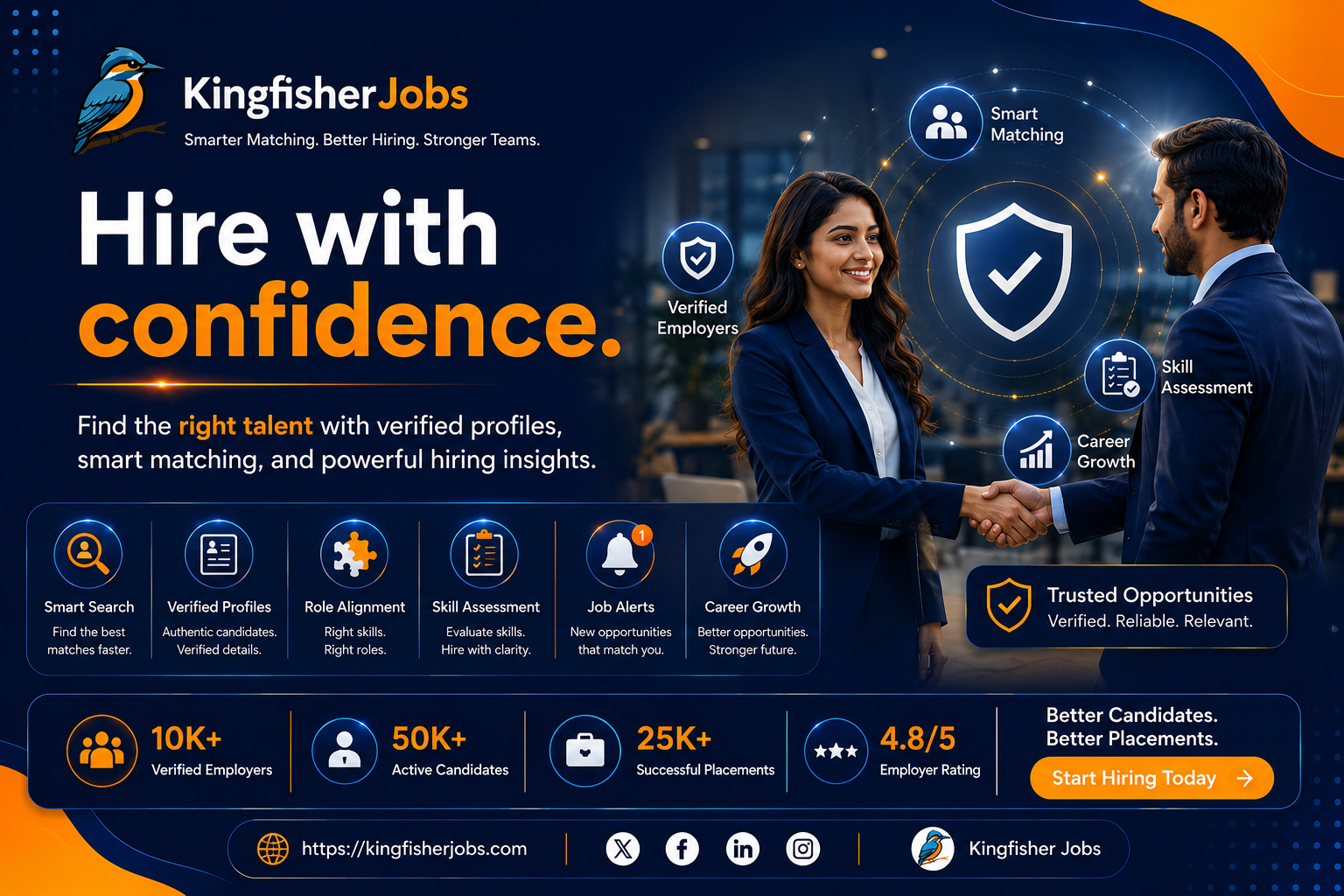
- Smart Search: Find stronger matches faster.
- Verified Profiles: Review candidate information with more trust.
- Role Alignment: Connect the right skills with the right roles.
- Skill Assessment: Understand candidate strengths more clearly.
- Job Alerts: Keep candidates updated on relevant opportunities.
- Career Growth: Support better long-term outcomes for job seekers.
By bringing these features together, Kingfisher Jobs helps create a recruitment process that is smarter, more reliable, and more focused on success.
Final Thoughts
Hiring with confidence is about more than choosing a candidate. It is about creating a recruitment process that gives employers the right information, connects them with the right talent, and supports better long-term results.
Kingfisher Jobs helps employers find verified profiles, use smart matching, assess skills, and connect with candidates who are better aligned with their roles. For candidates, it creates access to trusted opportunities and career growth possibilities.
Better candidates lead to better placements. Better placements lead to stronger teams. And stronger teams help businesses grow with confidence.
Start Hiring with Confidence Today
If your business is ready to find the right talent, improve candidate quality, and build stronger teams, Kingfisher Jobs can help you take the next step.
Website: https://kingfisherjobs.com