


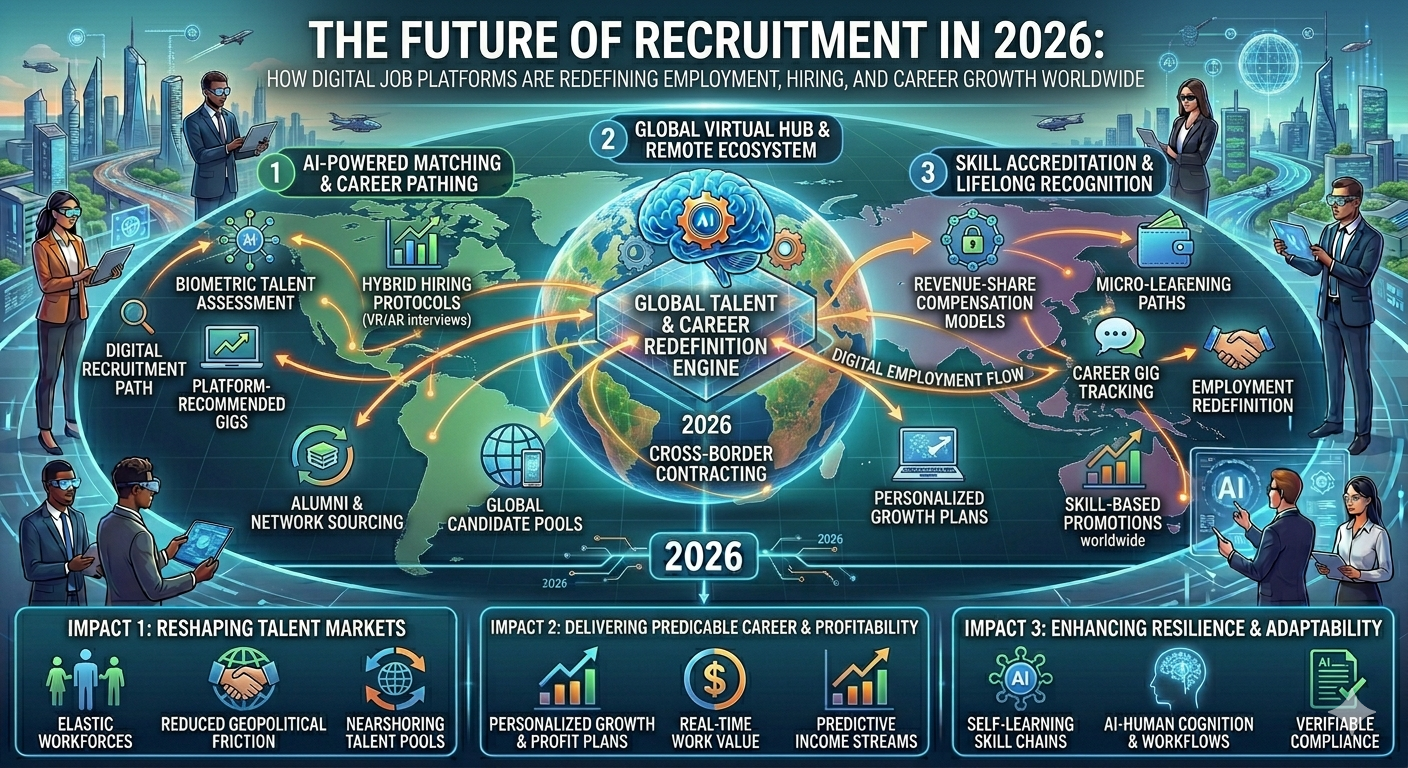
Introduction: A New Employment Era Is Emerging
The global employment landscape is undergoing a structural transformation that is reshaping how people find jobs and how companies hire talent. Traditional recruitment systems—once dependent on physical applications, newspaper advertisements, and manual HR processes—are being replaced by intelligent digital platforms that operate in real time.
In 2026, job searching is no longer a slow, uncertain process. It is now a data-driven, automated, and globally connected ecosystem where employers and candidates interact through structured digital platforms.
Modern job portals are not just listing vacancies. They are becoming career ecosystems that connect talent with opportunity through technology, speed, and precision.
Platforms like KingfisherJobs represent this shift—bridging the gap between employers seeking skilled professionals and candidates searching for meaningful careers.
1. The Evolution of Recruitment Systems
Recruitment has changed significantly over the last two decades. It has moved through three major phases:
1.1 Traditional Recruitment Era
- Newspaper job ads
- Walk-in interviews
- Physical CV submissions
- Recruitment agencies with limited reach
This system was slow, localized, and often inefficient.
1.2 Early Digital Transition
- Online job boards
- Email-based applications
- Basic company career pages
This phase improved accessibility but still lacked intelligence and automation.
1.3 Modern Intelligent Recruitment Systems
- AI-assisted job matching
- Real-time job updates
- Automated filtering and screening
- Global candidate reach
This is the current phase, where recruitment is no longer manual—it is system-driven and data-optimized.
2. Why Traditional Hiring Methods Are No Longer Effective
Traditional hiring processes face multiple limitations in today’s fast-moving job market.
2.1 Slow Hiring Cycles
Manual screening and interviews create long delays in recruitment.
2.2 Limited Talent Reach
Companies only access local or known networks instead of global talent pools.
2.3 High Operational Costs
Recruitment agencies, advertising, and manual HR processes increase hiring expenses.
2.4 Low Matching Accuracy
Without data-driven systems, hiring decisions are often based on subjective judgment.
These inefficiencies make traditional recruitment unsuitable for modern business environments.
3. The Rise of Digital Job Platforms
Digital job platforms have revolutionized how recruitment works by introducing structure, automation, and scalability.
These platforms allow:
- Instant job postings
- Global candidate visibility
- Automated application filtering
- Real-time communication between employers and candidates
- Centralized hiring dashboards
The result is a shift from reactive hiring to proactive talent acquisition.
Employers no longer wait for candidates to apply—they actively attract and filter talent through structured systems.
4. How Modern Job Platforms Operate
Modern recruitment platforms function as multi-layer ecosystems:
4.1 Job Posting Layer
Employers create detailed listings including:
- Job title
- Skills required
- Salary range
- Experience level
- Application deadlines
4.2 Candidate Profile Layer
Job seekers create profiles with:
- CV uploads
- Skills and experience details
- Career preferences
- Job alerts and bookmarks
4.3 Matching System Layer
The platform connects candidates with relevant jobs based on:
- Skills compatibility
- Experience level
- Industry alignment
- Location preferences
4.4 Communication Layer
Employers and candidates interact through:
- Application tracking
- Messaging systems
- Interview scheduling tools
4.5 Analytics Layer
Modern platforms analyze:
- Job application trends
- Candidate engagement
- Hiring success rates
- Market demand patterns
This creates a self-improving recruitment ecosystem.
5. The Importance of Data in Recruitment
Data has become the foundation of modern hiring decisions.
Job platforms now track:
- Candidate behavior patterns
- Job market demand trends
- Application success rates
- Industry salary benchmarks
- Hiring timelines
This data allows employers to:
- Optimize job descriptions
- Improve candidate targeting
- Reduce hiring time
- Increase recruitment efficiency
For example:
- If a job listing receives low-quality applications → filters are adjusted
- If hiring takes too long → salary or requirements are optimized
- If certain skills are in high demand → recruitment strategy is updated
Recruitment is now data-driven, not assumption-based.
6. Candidate Experience: A Critical Success Factor
In 2026, candidate experience plays a central role in recruitment success.
A poor experience leads to:
- Application drop-offs
- Low engagement
- Reduced trust in the platform
A strong experience includes:
- Simple application processes
- Clear job descriptions
- Fast response times
- Transparent hiring stages
Modern platforms focus heavily on reducing friction in the job search journey.
The easier it is to apply, the higher the engagement rate.
7. Benefits for Employers Using Digital Job Platforms
Employers benefit significantly from digital recruitment systems.
7.1 Faster Hiring
Automation reduces time-to-hire significantly.
7.2 Better Candidate Quality
Filtering systems ensure only relevant candidates apply.
7.3 Cost Efficiency
Reduces dependency on external recruitment agencies.
7.4 Wider Talent Access
Employers can reach candidates globally.
7.5 Scalable Recruitment
Multiple job openings can be managed simultaneously.
These advantages make digital platforms essential for modern hiring.
8. Changing Role of Job Seekers in 2026
The role of job seekers has also evolved significantly.
8.1 Skills-Based Hiring
Employers now prioritize skills over degrees alone.
8.2 Digital Presence Requirement
Online CVs and professional profiles are essential.
8.3 Continuous Learning
Skills must be updated regularly to remain competitive.
8.4 Faster Decision-Making
Job opportunities move quickly, requiring immediate responses.
Job seekers are no longer passive applicants—they are active participants in a competitive ecosystem.
9. Major Trends Shaping the Future of Recruitment
Several key trends are reshaping global hiring systems:
9.1 Artificial Intelligence in Hiring
AI is being used to match candidates with roles more accurately.
9.2 Remote Work Expansion
Companies are hiring globally without geographic limitations.
9.3 Gig Economy Growth
Freelance and contract-based jobs are increasing.
9.4 Automation in HR
Resume screening and interview scheduling are becoming automated.
9.5 Skills-Based Job Matching
Practical skills are becoming more important than academic qualifications.
These trends are redefining how careers are built.
10. Challenges in Modern Job Markets
Despite progress, challenges still exist:
10.1 High Competition
More candidates are competing for fewer roles.
10.2 Skill Gaps
Many candidates lack industry-relevant skills.
10.3 Job Authenticity Issues
Some platforms struggle with fake or outdated listings.
10.4 Rapid Industry Change
Technology evolves faster than workforce adaptation.
Solving these challenges requires better platforms and continuous skill development.
11. The Future of Job Platforms
The future of recruitment platforms is moving toward fully intelligent career ecosystems.
Expected developments include:
- AI-powered career advisors
- Predictive job matching systems
- Automated skill gap analysis
- Real-time employer-candidate interaction
- Personalized job recommendation engines
These systems will not just help users find jobs—they will actively guide career growth.
Conclusion: The Digital Recruitment Revolution Is Here
The recruitment industry is undergoing a complete transformation. Traditional hiring methods are being replaced by intelligent, data-driven systems that connect global talent with opportunities faster and more efficiently than ever before.
For job seekers, this means better access to opportunities and faster hiring decisions. For employers, it means higher-quality candidates and reduced recruitment costs.
Platforms like KingfisherJobs are at the center of this evolution, creating structured ecosystems that support both sides of the job market.
In 2026 and beyond, success in recruitment will depend not just on finding jobs or hiring candidates—but on how effectively individuals and organizations adapt to digital-first, intelligent hiring systems.