

Interviews can feel stressful, but confidence rarely comes from luck. It comes from preparation. When you understand the company, practise your answers, know your strengths and prepare real examples, you give yourself a much better chance of performing well when it matters.
Why Interview Preparation Matters
An interview is your opportunity to turn a CV into a real conversation. Employers already know some of your experience from your application, but the interview helps them understand how you think, communicate and approach responsibility.
Preparation helps you present that information clearly. Instead of trying to create answers under pressure, you arrive with a better understanding of the role and several useful examples already in mind.
This does not mean memorising every answer word for word. In fact, overly rehearsed responses can sound unnatural. The goal is to prepare your ideas so you can speak confidently and adapt naturally during the conversation.
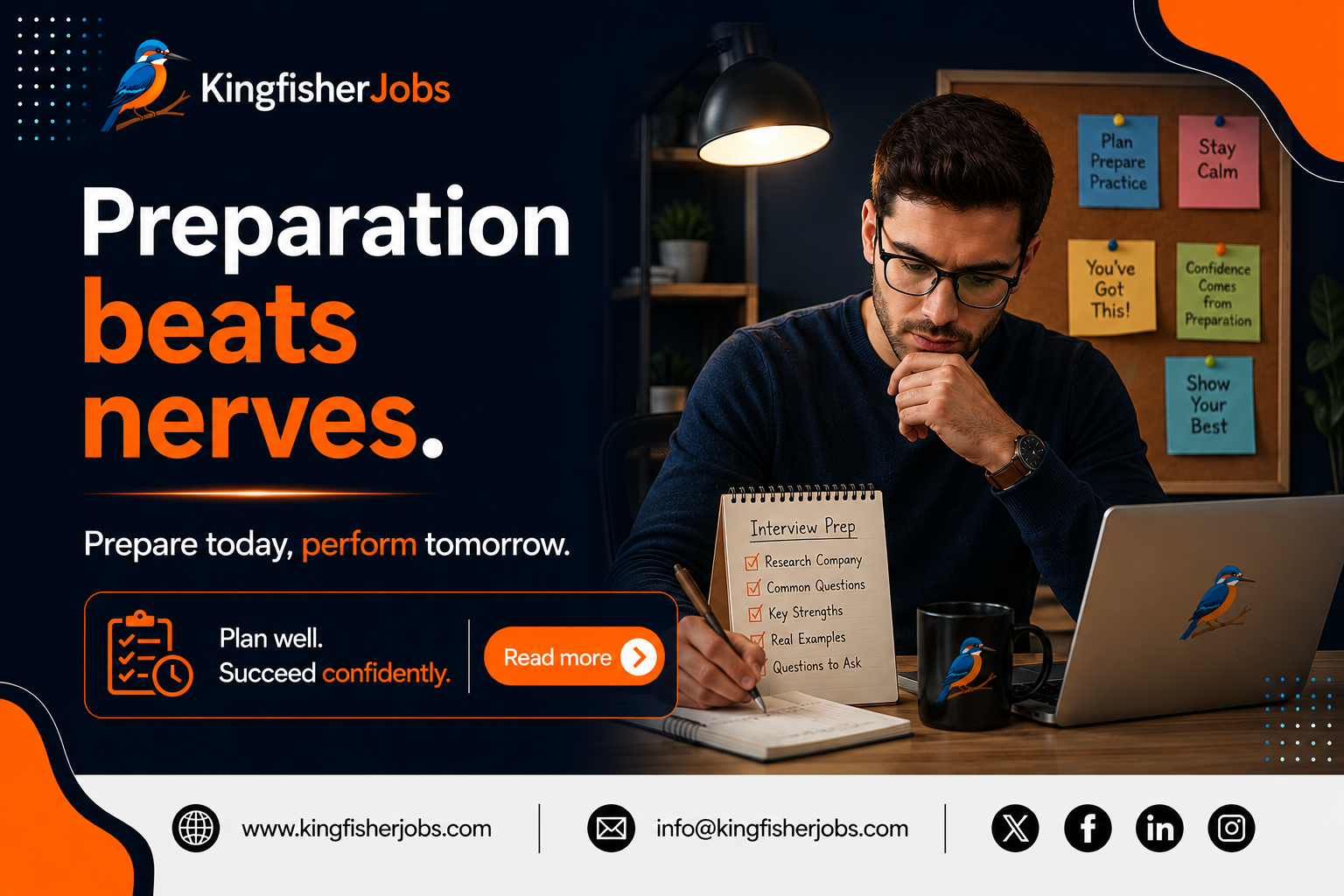
Preparation Beats Nerves.
You cannot control every interview question, but you can control how well prepared you are to respond.
Start by Understanding the Role
One of the biggest interview mistakes is focusing entirely on yourself without fully understanding what the employer actually needs.
Read the job description carefully before the interview. Look beyond the job title and identify the main responsibilities, skills and outcomes associated with the position.
Ask yourself:
- What are the most important responsibilities?
- Which skills appear repeatedly in the job description?
- What problems is the employer hiring someone to solve?
- Which parts of my experience match these requirements?
- Where can I provide evidence that I have performed similar work?
- What skills might I need to develop if I get the role?
Understanding the role helps you make your answers relevant rather than simply describing your entire work history.
Research the Company
Employers are more likely to be impressed by candidates who understand the organisation they are applying to join.
You do not need to memorise every detail about the business. You should, however, understand what the company does, who it serves and why the opportunity interests you.
Before the interview, research:
- The company’s main products or services.
- Its customers or target market.
- Its values and working culture where available.
- Recent company developments.
- The team or department connected to the role.
- How the position supports wider business goals.
Strong research helps you answer one of the most common interview questions: “Why do you want to work here?”
Prepare for Common Interview Questions
Every interview is different, but many employers use similar types of questions to understand candidates.
Preparing for these questions does not mean learning a script. It means deciding what information you want the interviewer to understand about you.
| Common Question | What the Employer May Be Assessing | How to Prepare |
|---|---|---|
| Tell me about yourself. | Communication and relevance | Prepare a short professional summary connected to the role. |
| Why do you want this job? | Motivation | Connect the opportunity with your skills and career goals. |
| What are your strengths? | Self-awareness | Select relevant strengths and support them with evidence. |
| Tell me about a challenge you faced. | Problem-solving | Prepare a clear example showing your actions and result. |
| Why should we hire you? | Value and fit | Summarise the experience and strengths that match the role. |
Know Your Key Strengths
Candidates sometimes struggle to talk about their strengths because they do not want to sound overconfident.
However, an interview is exactly the right time to explain what you do well. The key is to support your strengths with examples rather than making unsupported claims.
Instead of saying:
“I am a great communicator.”
You could explain:
“Communication is one of my strengths. In my previous role, I regularly coordinated updates between customers and the operations team, which helped reduce confusion and improve response times.”
Evidence makes strengths more credible.
Prepare Real Examples
Employers often ask behavioural questions because past examples can help them understand how you might respond in future situations.
Prepare several examples from your work, studies, volunteering or other relevant experience.
Useful examples might demonstrate:
- Solving a problem.
- Working successfully in a team.
- Handling pressure.
- Helping a customer.
- Meeting a difficult deadline.
- Learning something quickly.
- Taking responsibility.
- Resolving disagreement.
- Improving a process.
- Recovering from a mistake.
Use the STAR Method
The STAR method is a simple framework for answering questions that ask for real examples.
S — Situation
Briefly explain the context.
T — Task
Explain what you needed to achieve.
A — Action
Describe what you personally did.
R — Result
Explain the outcome and what you learned.
This structure helps prevent answers from becoming too long or unclear.
Keep Examples Focused
Interviewers usually need enough detail to understand the situation, but the most important part is what you did and what happened as a result.
Practise Without Sounding Rehearsed
Practice is one of the best ways to reduce interview nerves.
Saying answers aloud feels different from simply thinking about them. Practising can help you identify where explanations are too long, unclear or missing important detail.
However, avoid memorising complete sentences. If you forget one phrase, it can make you more nervous.
Instead, remember the main points you want to cover.
You can practise by:
- Answering questions aloud by yourself.
- Practising with a friend or family member.
- Recording yourself and reviewing the answer.
- Writing short bullet points rather than complete scripts.
- Completing a mock interview.
Prepare Questions to Ask the Employer
An interview is a two-way conversation. You are also deciding whether the role and organisation are right for you.
Asking thoughtful questions demonstrates interest and helps you gather information that may not be available in the job advert.
Good questions might include:
- What would success look like in this role during the first six months?
- What are the biggest priorities for the person joining the team?
- How is the team structured?
- What does a typical day look like?
- What learning or development opportunities are available?
- What do you enjoy most about working here?
- What are the next steps in the recruitment process?
Prepare at least three questions. Some may already be answered during the interview, so having several options gives you flexibility.
Prepare for Video Interviews
Online interviews require the same preparation as face-to-face interviews, with a few additional practical checks.
Technology problems can create unnecessary stress, so test your setup before the interview begins.
Before a video interview:
- Check your internet connection.
- Test the camera and microphone.
- Make sure the meeting link works.
- Choose a quiet location.
- Use a simple and professional background.
- Position the camera around eye level.
- Close unnecessary applications and notifications.
- Keep your CV and useful notes nearby.
Prepare for Face-to-Face Interviews
For in-person interviews, practical planning can remove a significant amount of unnecessary stress.
Know where you are going and how long the journey should take. Allow extra time for traffic, parking or public transport disruption.
- Confirm the interview address.
- Plan your route in advance.
- Know who you are meeting.
- Take a copy of your CV if appropriate.
- Choose your clothing the day before.
- Aim to arrive slightly early rather than exactly on time.
How to Handle Interview Nerves
Feeling nervous before an interview is completely normal. In many cases, nerves simply mean that the opportunity matters to you.
The goal is not necessarily to remove every nervous feeling. It is to prevent those feelings from controlling the interview.
Try these practical techniques:
- Prepare early instead of the night before.
- Give yourself enough travel or setup time.
- Pause briefly before answering difficult questions.
- Take a sip of water when needed.
- Listen carefully instead of planning your answer while the interviewer speaks.
- Remember that the interviewer wants the conversation to go well too.
Confidence Comes From Preparation
You do not need to know every answer instantly. Good communication includes taking a moment to think before responding.
What to Do When You Do Not Know an Answer
Sometimes an interviewer will ask something you did not expect.
Do not panic and do not invent experience you do not have.
A thoughtful and honest response is usually stronger than pretending.
You might say that you have not encountered that exact situation before, then explain how you would approach it or describe a related example.
Employers often care about your thinking process as much as the final answer.
Common Interview Mistakes to Avoid
| Mistake | Better Approach |
|---|---|
| Arriving without researching the company | Understand the organisation and role beforehand. |
| Giving very long answers | Keep answers focused and relevant. |
| Speaking negatively about previous employers | Remain professional and focus on what you learned. |
| Claiming strengths without evidence | Support important claims with examples. |
| Having no questions for the interviewer | Prepare several meaningful questions. |
Your Interview Preparation Checklist
Use this checklist before your next interview:
- ☑ Read the job description carefully.
- ☑ Research the company.
- ☑ Prepare your professional introduction.
- ☑ Identify your most relevant strengths.
- ☑ Prepare real examples.
- ☑ Practise common questions.
- ☑ Prepare questions for the employer.
- ☑ Check interview time and location.
- ☑ Test technology for online interviews.
- ☑ Prepare clothing and documents.
- ☑ Get enough rest the night before.
What to Do After the Interview
Your learning does not have to stop when the interview ends.
Take a few minutes afterwards to reflect on the conversation while it is still fresh.
Consider:
- Which answers went particularly well?
- Which questions were difficult?
- Were there examples you wish you had explained better?
- Did you learn anything new about the role?
- Would you still be interested if an offer was made?
Every interview can make you better prepared for the next one, regardless of the final outcome.
Preparation Helps You Show Your Best
An interview should not be about pretending to be someone else. It is about communicating the strongest and most relevant version of your real experience.
Preparation helps you remember examples, communicate clearly and focus on the conversation instead of worrying about what might happen next.
When you know the role, understand the company and have thought carefully about your experience, nervousness becomes easier to manage.
Plan Well. Succeed Confidently.
Preparation does not guarantee the outcome, but it gives you the best opportunity to communicate your value when the opportunity arrives.
Find Your Next Opportunity with KingfisherJobs
Strong interview preparation starts with finding opportunities that match your skills, experience and career goals.
KingfisherJobs helps job seekers discover vacancies and connect with employers looking for talent.
Whether you are looking for your first role, your next career move or a fresh opportunity in a different sector, taking the time to prepare can help you approach each interview with greater confidence.
Ready for Your Next Opportunity?
Explore opportunities with KingfisherJobs, prepare with purpose and give yourself the confidence to perform at your best.
Website: www.kingfisherjobs.com | Email: info@kingfisherjobs.com
Frequently Asked Questions
How should I prepare for a job interview?
Review the job description, research the employer, prepare examples of your experience, practise common questions and create several questions to ask the interviewer.
How can I stop feeling nervous during an interview?
Preparation and practice can significantly reduce uncertainty. Arrive early, listen carefully, take your time when answering and remember that some nervousness is completely normal.
Should I memorise interview answers?
It is usually better to prepare key points and examples rather than memorising complete answers. This helps your responses sound more natural and allows you to adapt to the exact question.
What is the STAR interview method?
STAR stands for Situation, Task, Action and Result. It provides a clear structure for answering behavioural questions using examples from your experience.
What questions should I ask at the end of an interview?
Ask questions that help you understand the role, team, priorities, expectations, development opportunities and next steps in the recruitment process.
What should I do if I do not know an interview answer?
Stay calm and be honest. Take a moment to think, explain how you would approach the situation or provide a related example if you do not have direct experience.