

Landing the right job is rarely about luck alone. Your experience, qualifications and skills may help you secure an interview, but what you do before that interview can make a significant difference to how confidently and effectively you present yourself.
At KingfisherJobs, we believe that preparation gives candidates the opportunity to show employers what they can genuinely bring to a role. From researching the company and understanding the job description to preparing examples and practising your answers, every step helps you walk into an interview with greater clarity and confidence.
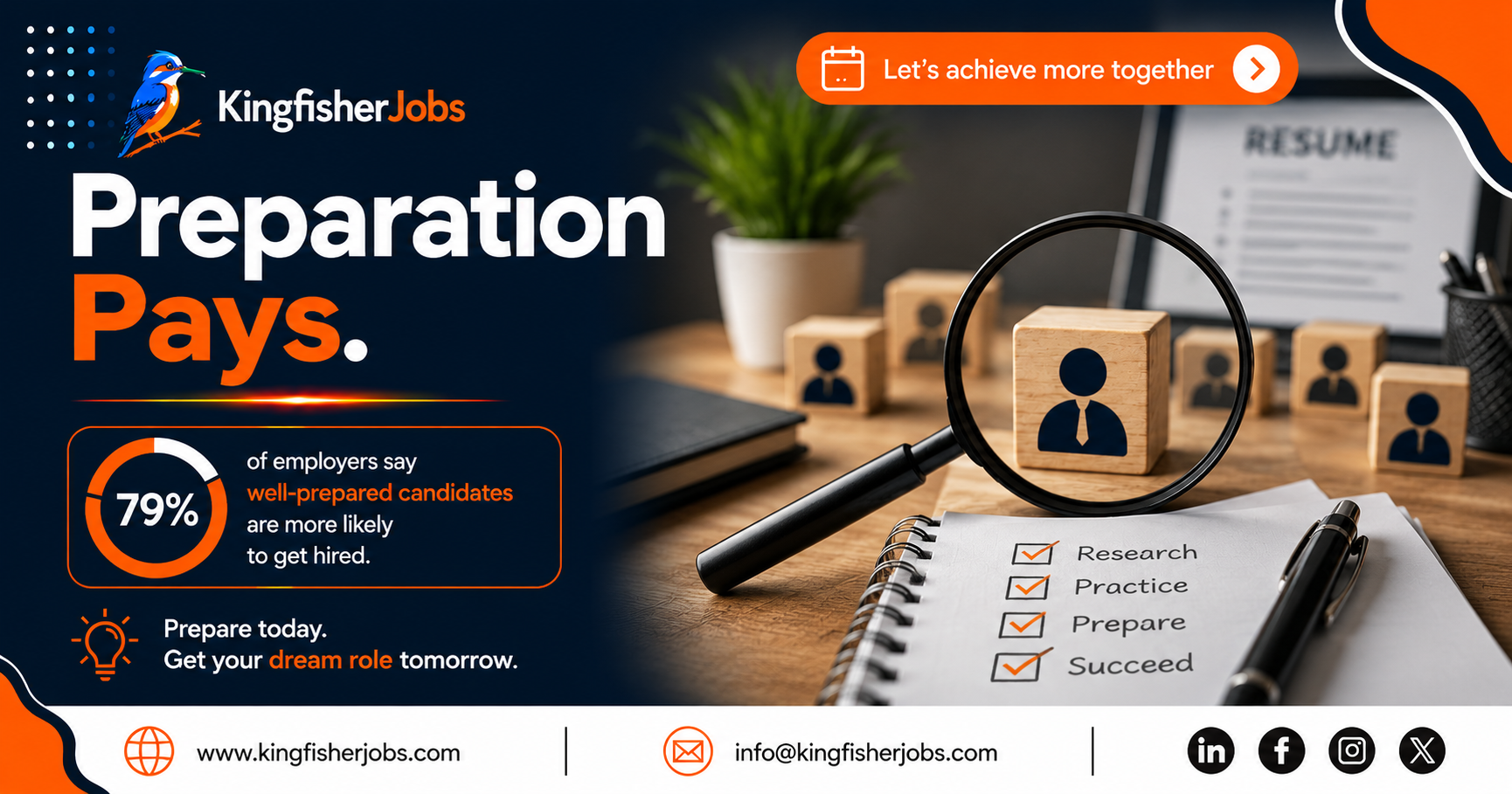
The message is simple: Preparation Pays. Prepare today, and you can put yourself in a stronger position to secure your dream role tomorrow.
Why Job Interview Preparation Matters
An interview is your opportunity to turn the information on your CV into a compelling conversation. Employers already have an idea of your employment history and qualifications. The interview helps them understand how you communicate, how your experience relates to their vacancy and whether you could be the right fit for their organisation.
Good preparation helps you make the most of that opportunity.
When candidates prepare properly, they are generally better equipped to:
- Explain their experience clearly and confidently
- Connect their skills to the requirements of the role
- Provide relevant examples of previous achievements
- Answer challenging questions without becoming overwhelmed
- Demonstrate genuine interest in the employer
- Ask thoughtful questions about the opportunity
- Communicate their value more effectively
- Approach the interview with greater confidence
Preparation does not mean memorising perfect answers. In fact, heavily scripted responses can sometimes make a conversation feel unnatural. The objective is to understand what you want to communicate so that you can respond naturally when questions are asked.
Start by Understanding the Job Description
One of the most important pieces of interview preparation is also one of the simplest: read the job description carefully.
Do not just scan the job title and basic requirements. Look closely at the responsibilities, essential skills, desirable experience and language the employer uses to describe its ideal candidate.
As you review the vacancy, identify the requirements that appear most important. Then consider where your own experience provides evidence that you can meet them.
Turn Requirements Into Examples
If the employer wants someone with strong leadership skills, prepare an example of a time you successfully led people or a project. If communication is important, think about situations where your communication helped solve a problem, manage a customer or coordinate colleagues.
For each major requirement, ask yourself:
- Have I done something similar before?
- What specific example demonstrates this skill?
- What challenge was I facing?
- What did I personally do?
- What was the result?
This approach helps transform broad statements such as “I am a good problem solver” into credible evidence of your abilities.
Research the Company Before Your Interview
Employers frequently want to know why you are interested in their organisation, not simply why you want another job.
Research allows you to provide a more meaningful answer.
Before attending an interview, familiarise yourself with the company’s business, services or products, customers, industry and recent developments where relevant.
Useful areas to research can include:
- The company’s main products or services
- Its customers and markets
- Company values and culture
- Recent company news or developments
- The organisation’s website and professional social channels
- The wider industry in which it operates
- Information about the team or department you may be joining
You do not need to memorise every page of the employer’s website. Instead, develop enough understanding to explain why the organisation and opportunity genuinely interest you.
Know Your Own CV
Your CV is likely to form the foundation of many interview questions. You should therefore be comfortable discussing everything included on it.
Review your employment history before the interview and refresh your memory about previous responsibilities, projects and achievements.
Pay particular attention to achievements that demonstrate measurable impact. For example, rather than simply saying that you managed customers, you may be able to explain how you improved retention, increased sales, resolved a difficult issue or developed an important account.
Be Ready to Explain Career Changes
Interviewers may ask why you left previous positions, why you want to change careers or why there are gaps in your employment history.
Prepare straightforward, professional explanations. Avoid becoming defensive or speaking negatively about previous employers. Keep your answer focused on your circumstances, development and what you are looking for next.
Prepare for Common Interview Questions
No two interviews are identical, but certain themes appear regularly. Preparing for these themes can make it easier to organise your thoughts.
Common questions include:
- Tell me about yourself.
- Why are you interested in this position?
- Why do you want to work for our company?
- What are your key strengths?
- What achievement are you most proud of?
- Tell me about a difficult problem you solved.
- Describe a time you worked under pressure.
- Tell me about a disagreement or challenge at work.
- Why are you looking to leave your current position?
- What are you looking for in your next role?
Rather than writing a word-for-word script, make brief notes covering the key points you want to communicate. This helps you remain prepared while still sounding natural.
Use the STAR Method for Competency-Based Questions
Competency-based interview questions often ask you to describe a real situation from your previous experience. The STAR method can help you structure these answers clearly.
Situation
Briefly explain the context. What was happening and why did it matter?
Task
Explain your responsibility or what you needed to achieve.
Action
Describe what you actually did. This should usually be the most detailed part of your answer.
Result
Explain the outcome. Where possible, provide specific evidence such as an improvement, successful delivery, positive feedback, increased revenue, reduced costs or another measurable result.
STAR answers can help prevent candidates from giving vague responses because they provide the interviewer with context, evidence and an outcome.
Practice Your Answers Without Sounding Rehearsed
Knowing what you want to say and actually saying it confidently can be very different things. This is why practice matters.
Try answering interview questions aloud rather than simply thinking about your responses. Speaking forces you to organise your ideas into complete answers and can reveal areas where your explanation is too long, unclear or missing important information.
You could practise with a friend, family member or recruitment professional. You can also record yourself answering several questions and listen back to identify areas for improvement.
The goal is not perfection. It is familiarity.
When you have already discussed your experience aloud, it can feel much easier to explain it naturally during the real interview.
Prepare Your Own Questions for the Employer
An interview should not be entirely one-sided. It is also your opportunity to determine whether the role and organisation are suitable for you.
Prepare several questions before the interview. Good questions can demonstrate curiosity while giving you information that may help you evaluate the opportunity.
You might ask:
- What would success look like in this position during the first six months?
- What are the immediate priorities for the person joining the team?
- How is the team structured?
- What are the biggest challenges associated with this role?
- How would you describe the working culture?
- What development opportunities are available?
- How is performance typically measured?
- What are the next stages of the recruitment process?
Avoid asking questions simply for the sake of having something to say. Focus on information that genuinely helps you understand the position.
Prepare for In-Person Interviews
For a face-to-face interview, practical preparation can remove unnecessary stress on the day.
Confirm the location in advance and check how long your journey is likely to take. Give yourself additional time for traffic, parking, public transport delays or difficulty finding the building.
You should also prepare anything you may need, such as:
- A copy of your CV
- The job description
- A notebook and pen
- Relevant portfolio or work examples where appropriate
- Any documents specifically requested by the employer or recruiter
Choose appropriate clothing in advance rather than making the decision immediately before leaving. What is suitable will depend on the employer and industry, but appearing professional and well prepared is generally a sensible approach.
Prepare for Video Interviews
Online interviews require preparation too. Technology problems can interrupt an otherwise strong conversation, so test your setup beforehand.
Check your internet connection, camera, microphone and the video platform being used. Position yourself somewhere quiet with appropriate lighting and a clean, distraction-free background.
Close unnecessary applications and silence notifications before the interview begins.
Keep your CV and a few concise notes nearby, but avoid continuously reading from them. Maintaining natural engagement with the interviewer remains important even when the conversation is taking place through a screen.
First Impressions Still Matter
Technical skills and experience may determine whether you are qualified for a position, but communication and professionalism influence how effectively you demonstrate those qualities.
Whether the interview is online or in person, aim to be punctual, polite and engaged.
Listen carefully to each question before answering. If you do not understand something, asking for clarification is usually better than answering a question you have misunderstood.
There is also nothing wrong with taking a brief moment to think before responding to a difficult question. A considered answer can be more effective than rushing into the first response that comes to mind.
What to Do When You Don’t Know an Answer
Not every interview question will be predictable. You may encounter something you have never considered before.
Do not panic.
Take a moment to understand what the interviewer is asking. If you do not have an exact example, you may be able to discuss a comparable situation or explain how you would approach the scenario.
Most importantly, avoid inventing experience you do not have. Being transparent about your current knowledge while demonstrating your ability and willingness to learn can provide a much stronger foundation for the conversation.
Common Interview Preparation Mistakes
Knowing what not to do can be just as useful as knowing what to prepare.
Doing No Company Research
If you cannot explain what the company does or why the position interests you, it can be difficult to demonstrate genuine motivation.
Memorising Scripts
Over-rehearsed answers can sound unnatural and may become difficult to adapt when an interviewer phrases a question differently.
Giving Generic Answers
Statements such as “I work hard” or “I am a team player” are stronger when supported with specific examples.
Talking Too Much
Detailed answers can be valuable, but lengthy responses can lose focus. Try to answer the actual question before adding supporting detail.
Speaking Negatively About Previous Employers
Even if you had a difficult experience, keep your explanation professional and focus on what you learned or what you want from your next opportunity.
Having No Questions
Arriving without anything you want to ask can mean missing an important opportunity to learn more about the role.
Preparation Builds Confidence
Interview nerves are completely normal. Preparation cannot guarantee that you will feel no nerves at all, but it can reduce uncertainty.
When you know the company, understand the vacancy and have thought carefully about your relevant experience, you have a stronger foundation for the conversation.
Instead of trying to invent answers under pressure, you can focus on communicating examples and information you have already considered.
That confidence can also help you listen more carefully and engage more naturally with the interviewer.
Preparation Is About Finding the Right Role, Not Just Any Role
Successful recruitment should work for both sides.
The employer wants someone who can perform the role and contribute to the organisation. As a candidate, you want an opportunity that fits your skills, ambitions, circumstances and career goals.
Interview preparation should therefore include thinking about what you want.
Consider factors such as:
- The responsibilities you want to take on
- The skills you want to develop
- The type of working environment you prefer
- Your longer-term career objectives
- The opportunities for progression
- Working arrangements that matter to you
Knowing your priorities can help you ask better questions and evaluate opportunities more thoughtfully.
How a Recruitment Partner Can Help You Prepare
A good recruitment relationship should involve more than simply sending a CV to an employer.
Recruiters can often provide useful context about the opportunity, helping candidates understand what an employer is looking for and what to expect from the recruitment process.
At KingfisherJobs, our goal is to connect candidates and employers while helping people approach opportunities with the preparation needed to present themselves effectively.
When you understand the role, research the organisation, practise your answers and prepare relevant examples, you give yourself the opportunity to show what you can genuinely offer.
Your Interview Preparation Checklist
Before your next interview, work through this simple checklist:
- Research: Learn about the company, industry and role.
- Review: Read the job description and identify its most important requirements.
- Match: Connect those requirements to your skills and experience.
- Prepare: Select strong examples that demonstrate your abilities.
- Practice: Answer likely interview questions aloud.
- Plan: Prepare thoughtful questions for the interviewer.
- Check: Confirm the interview location or test your video setup.
- Organise: Have your CV, notes and any requested documents ready.
- Present: Be punctual, professional and engaged.
- Succeed: Focus on communicating your experience naturally and confidently.
Frequently Asked Questions About Job Interview Preparation
How should I prepare for a job interview?
Start by reviewing the job description and researching the employer. Identify your experience that relates directly to the role, prepare examples of your achievements, practise common interview questions and prepare several questions of your own. You should also confirm practical details such as the interview time, location or video platform.
How much company research should I do before an interview?
You should understand what the organisation does, its main products or services, the market it operates in and why you are interested in joining it. Depending on the position, researching recent company developments and the wider industry may also be useful.
What is the STAR interview technique?
STAR stands for Situation, Task, Action and Result. It is a method for structuring examples when answering competency-based interview questions. It helps you explain the context, your responsibility, what you personally did and what happened as a result.
Should I memorise answers before an interview?
It is usually better to prepare key points and examples rather than memorising complete scripts. This allows you to answer naturally and adapt your response to the specific question being asked.
What should I take to an interview?
For an in-person interview, consider taking a copy of your CV, the job description, a notebook and pen, relevant work examples where appropriate, and anything specifically requested by the employer or recruiter.
How can I feel more confident before an interview?
Preparation and practice can help reduce uncertainty. Research the company, understand the role and practise discussing your experience aloud. Also plan practical details in advance so you are not dealing with avoidable problems immediately before the interview.
What questions should I ask at the end of an interview?
Ask questions that help you understand the opportunity, such as what success looks like in the role, the immediate priorities, how the team is structured, how performance is measured and what the next stage of the recruitment process involves.
What should I do after a job interview?
Take a few minutes to reflect on the discussion while it is still fresh. Note anything important you learned about the role and consider whether the opportunity still matches your goals. If you are working with a recruiter, provide feedback promptly so they can support the next stage of the process.
Preparation Pays: Get Ready for Your Next Opportunity
Your CV may open the door, but preparation helps you make the most of the opportunity once you are in the room.
Research the employer. Understand the vacancy. Know your experience. Practise your examples. Prepare your questions. Then approach the conversation ready to demonstrate what you can bring to the role.
Prepare today. Get your dream role tomorrow.
Ready to Take the Next Step in Your Career?
Connect with KingfisherJobs and discover opportunities that can help you move your career forward.
Website: www.kingfisherjobs.com
Email: info@kingfisherjobs.com
Let’s achieve more together.