

A successful career rarely develops by accident. While unexpected opportunities can certainly influence your journey, meaningful long-term progress usually begins with knowing where you want to go and taking deliberate steps to get there.
That is the value of setting clear career goals.
Whether you are looking for your first professional opportunity, considering a career change, developing new skills or aiming for greater responsibility, having a clear target can help you make more purposeful decisions.
At KingfisherJobs, we believe career development is about more than finding the next vacancy. It is about understanding what you want from your working life, recognising the skills and experience you need, and identifying opportunities that can move you towards a brighter future.
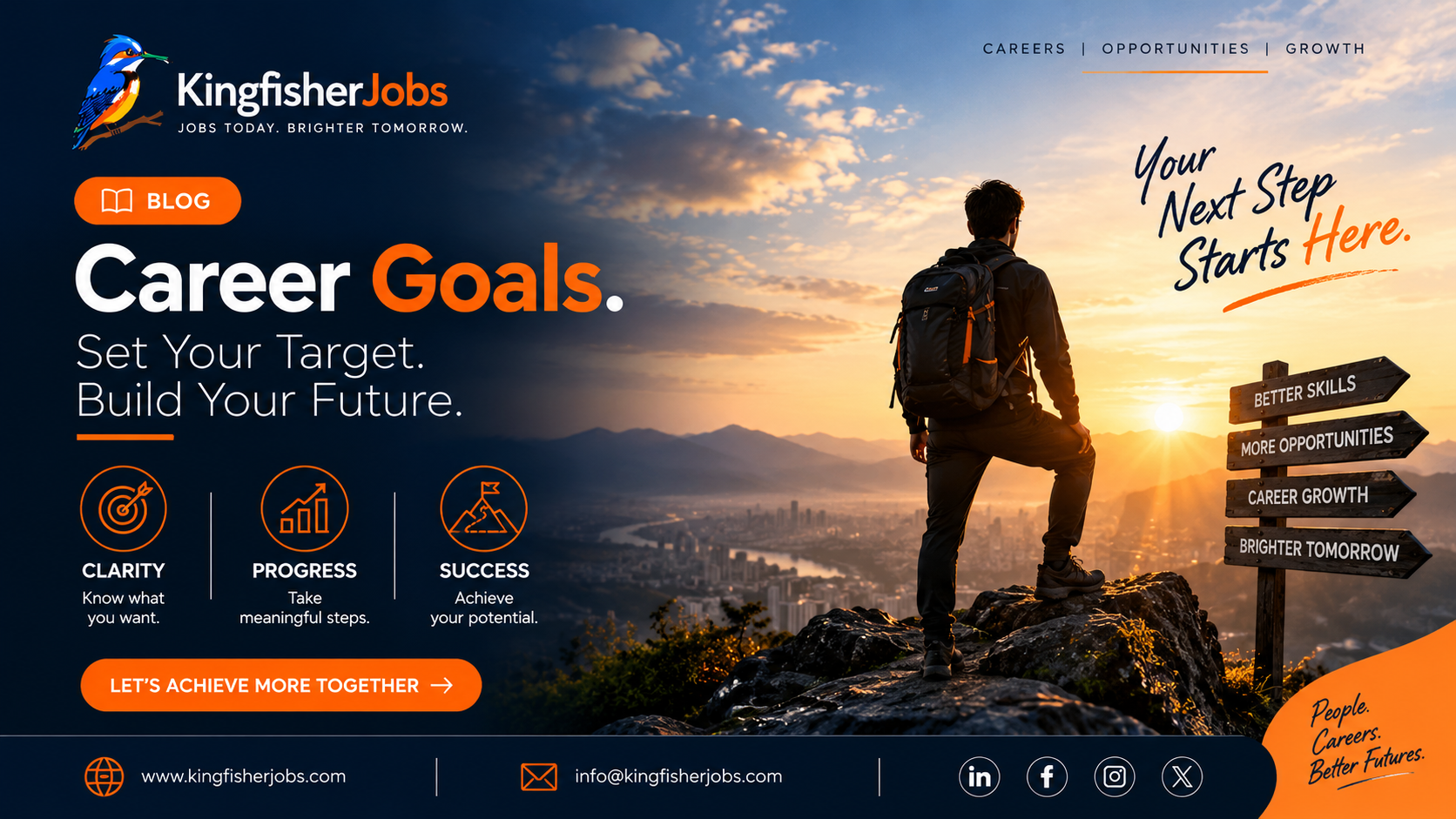
Set your target. Build your future. Your next step starts here.
What Are Career Goals?
Career goals are the professional outcomes you want to achieve over a particular period of time. They provide direction and help you decide which opportunities, skills and experiences are most relevant to your future.
A career goal could be relatively immediate, such as securing a new position, or much broader, such as progressing into leadership or moving into an entirely different profession.
Examples of career goals include:
- Finding your first professional role
- Moving into a new industry
- Developing a specialist skill
- Increasing your level of responsibility
- Progressing into management or leadership
- Improving your earning potential
- Achieving a better work-life balance
- Gaining professional qualifications
- Building experience in a particular field
- Finding work that better matches your strengths and interests
The right career goal will be different for every individual. What matters is that the goal is meaningful to you and provides enough direction to influence the decisions you make next.
Why Career Goals Matter
Without a clear destination, it is easy to move from job to job without understanding whether each move is actually taking you closer to the career you want.
Career goals provide a reference point.
When an opportunity appears, you can ask whether it supports your longer-term direction. When deciding which skills to develop, you can prioritise those most relevant to your target. When preparing for an interview, you can explain how the position fits into your professional development.
Clear goals can help create:
- Clarity: You understand what you are working towards.
- Focus: You can concentrate on opportunities that support your objectives.
- Motivation: Progress becomes easier to recognise.
- Direction: Career decisions become more purposeful.
- Confidence: You can explain what you want and why.
- Progress: Large ambitions can be broken into manageable steps.
Clarity Comes Before Progress
Before deciding how to reach your career destination, you need some understanding of what that destination looks like.
This does not mean you need to know exactly what you want to be doing twenty years from now. Careers evolve, industries change and priorities develop over time.
Instead, begin with your next meaningful direction.
Ask yourself:
- What type of work do I enjoy?
- Which tasks bring out my strongest abilities?
- What kind of working environment suits me?
- What would I like to learn next?
- Which responsibilities would I like to take on?
- What matters most to me in my next role?
- Where would I like my career to be in two or three years?
You do not need perfect answers. The purpose is to create enough clarity to identify a sensible next step.
Set Your Target
A target turns a general ambition into something you can work towards.
For example, saying “I want a better job” provides limited direction.
A clearer target might be:
“I want to move into a role that gives me greater responsibility, allows me to use my project-management experience and provides a clear route towards leadership.”
That statement immediately provides more information about what opportunities may or may not be suitable.
The clearer the target, the easier it becomes to identify the steps required to reach it.
Short-Term vs Long-Term Career Goals
Career planning becomes easier when you separate immediate objectives from longer-term ambitions.
Short-Term Career Goals
These are objectives you may reasonably work towards over the coming weeks, months or couple of years.
They might include:
- Updating your CV
- Improving your LinkedIn profile
- Completing a professional course
- Learning a new technical skill
- Applying for positions at the next level
- Building experience in a particular area
- Improving your interview skills
Long-Term Career Goals
Longer-term goals provide broader direction and may take several years to achieve.
Examples include:
- Becoming a department manager
- Moving into senior leadership
- Establishing yourself as a specialist
- Changing professional fields
- Developing an international career
- Reaching a particular level of professional responsibility
Your short-term goals should ideally contribute to your longer-term direction.
Turn Career Ambition Into an Action Plan
Having a goal is useful. Having a plan makes it actionable.
Imagine that your target is to move into a management position. Rather than simply waiting for the right vacancy, consider what would make you a stronger candidate.
Your plan might include:
- Taking responsibility for a project
- Developing people-management experience
- Improving communication and leadership skills
- Finding a mentor
- Completing relevant training
- Updating your CV with measurable achievements
- Researching management opportunities
- Preparing examples that demonstrate leadership potential
The destination remains the same, but you now have a route towards it.
Identify the Gap Between Where You Are and Where You Want to Be
Once you have identified a career target, compare it with your current position.
This is sometimes called a skills-gap analysis.
Look at several areas:
| Area | Questions to Consider |
|---|---|
| Skills | Which skills does my target role require that I still need to develop? |
| Experience | What practical experience would make me a stronger candidate? |
| Qualifications | Are any certifications or qualifications commonly expected? |
| Knowledge | What industry or technical knowledge should I strengthen? |
| Network | Who could help me better understand this field or profession? |
| Presentation | Does my CV clearly demonstrate that I am ready for the next step? |
Identifying gaps should not discourage you. It gives you a practical development plan.
Build the Skills Your Future Career Needs
The employment market continues to evolve, and developing relevant skills is one of the most practical ways to strengthen your career prospects.
Skill development can take many forms.
You might complete formal training, learn through online resources, volunteer for additional responsibilities, participate in projects or develop your abilities through everyday work.
Depending on your career direction, valuable skills may include:
- Communication
- Leadership
- Project management
- Problem-solving
- Digital skills
- Data analysis
- Commercial awareness
- Customer service
- Negotiation
- Industry-specific technical expertise
Focus on skills that support the career direction you have chosen rather than collecting qualifications without a clear purpose.
Better Skills Can Create More Opportunities
Career development often follows a simple relationship:
Better skills → stronger capability → more opportunities → greater career choice.
Developing your abilities can make you suitable for roles that previously felt out of reach.
It can also help you demonstrate adaptability. Employers frequently need people who can learn, respond to change and take on new responsibilities.
Continuous development is therefore not only about securing your next job. It can help create greater flexibility throughout your career.
Make Your Career Goals SMART
One way to make career goals more actionable is to use the SMART framework.
Specific
Define exactly what you want to achieve rather than using a vague ambition.
Measurable
Determine how you will recognise progress or completion.
Achievable
Your target should challenge you while remaining realistic enough to work towards.
Relevant
The goal should support your wider career direction.
Time-Bound
Give yourself a reasonable timeframe or review point.
For example:
Vague goal: “I want to improve my career.”
Clearer goal: “Over the next six months, I will develop the skills and application materials required to begin applying for roles with greater project responsibility.”
The second version creates a much clearer basis for action.
Your CV Should Reflect Your Career Direction
Your CV is not simply a historical record of everything you have ever done.
It should help employers understand why your experience is relevant to the position you want next.
When reviewing your CV, consider whether it clearly demonstrates:
- Relevant skills
- Professional achievements
- Increasing responsibility
- Results you have contributed to
- Relevant qualifications
- Experience connected with your target role
If your career goal changes, your CV may need to change as well.
For example, somebody seeking their first management position may need to place greater emphasis on mentoring colleagues, leading projects, coordinating teams or taking ownership of important outcomes.
Focus on Achievements, Not Only Responsibilities
Job descriptions explain what you were responsible for. Achievements demonstrate what happened because of your contribution.
Where possible, show the impact of your work.
Instead of writing:
“Responsible for managing customer enquiries.”
You might explain how you improved response times, maintained service standards, handled a significant workload or contributed to customer retention.
The exact evidence will depend on your role, but the principle is consistent: demonstrate value rather than simply listing duties.
Build a Professional Online Presence
For many candidates, professional visibility extends beyond the CV.
A well-maintained professional profile can help recruiters and employers understand your experience, capabilities and career interests.
Review your online professional presence and consider whether it reflects the direction you want your career to take.
Pay particular attention to:
- Your professional headline
- Your summary or profile
- Employment history
- Skills
- Qualifications
- Professional achievements
Consistency between your CV and professional profiles can make your career story easier to understand.
Use Job Descriptions as Career Research
You do not need to wait until you are ready to apply before looking at vacancies.
Job descriptions can provide valuable information about the skills and experience employers expect.
Search for several positions similar to your target role and identify recurring requirements.
You might notice that employers consistently request a particular qualification, technical skill, software platform or level of management experience.
That information can help you decide what to develop next.
Instead of guessing what your future career requires, you can use the employment market itself as a source of research.
Career Progress Is Built Through Meaningful Steps
A major career goal can feel overwhelming when viewed as one enormous leap.
Breaking it into smaller milestones makes progress more manageable.
For example:
Target: Move into a new professional field.
Your milestones might be:
- Research the profession
- Identify transferable skills
- Speak with people working in the sector
- Complete relevant training
- Gain practical experience
- Update your CV
- Begin targeted applications
- Prepare for industry-specific interviews
Each completed milestone brings the larger goal closer.
Do Not Confuse Speed With Progress
Career development is not a race.
Some people progress quickly. Others take a less direct route. Responsibilities outside work, economic conditions, industry changes and personal priorities can all influence the pace of development.
What matters is whether your decisions continue moving you towards a career that works for you.
A smaller step in the right direction can be more valuable than a dramatic move that takes you away from your longer-term objectives.
Career Goals Can Change
Setting a goal does not mean committing to the same destination forever.
As you gain experience, you may discover new strengths, interests and priorities.
You may realise that the career path you once wanted no longer suits you. Alternatively, a new opportunity may reveal a direction you had never previously considered.
This is normal.
Career goals should provide direction without preventing you from adapting when circumstances or priorities genuinely change.
Review Your Career Goals Regularly
Career planning should be an ongoing process rather than something you consider only when you want to leave a job.
Schedule occasional career reviews and ask:
- Am I still working towards the career I want?
- What have I learned since my last review?
- Which new skills have I developed?
- Where have I made progress?
- What is currently holding me back?
- Have my priorities changed?
- What should my next meaningful step be?
Regular reflection can prevent you from remaining on a path simply because it is familiar.
What If You Do Not Know Your Career Goal Yet?
Not everyone has a clearly defined career ambition, and you do not need to invent one simply because career advice tells you that you should.
If you are uncertain, start with exploration.
Consider what you already know about yourself:
- What type of work do you enjoy?
- What are you naturally good at?
- Which responsibilities do you want more of?
- Which responsibilities would you prefer to avoid?
- What type of organisation appeals to you?
- What matters most: progression, flexibility, earnings, purpose, stability, learning or something else?
You can also research different roles, speak with recruiters, explore job descriptions and talk to professionals working in fields that interest you.
Your immediate goal might simply be to understand your options better.
How to Evaluate a New Job Opportunity
A higher salary or impressive job title can be attractive, but neither automatically makes an opportunity right for your longer-term career.
Before making a decision, consider the complete opportunity.
| Factor | Question to Ask |
|---|---|
| Role | Will I enjoy the actual responsibilities? |
| Development | What new skills or experience will I gain? |
| Progression | Could this position support my longer-term goals? |
| Culture | Does the working environment suit me? |
| Management | Will I receive the support I need to perform and develop? |
| Reward | Is the overall package appropriate for the role? |
| Practical Fit | Does the location, schedule and working arrangement fit my circumstances? |
Evaluating the whole opportunity can help you make a more informed career decision.
Prepare for the Opportunities You Want
Career opportunities can sometimes appear unexpectedly. Preparation helps you respond when they do.
Keep your CV reasonably current. Maintain records of achievements and responsibilities. Continue developing useful skills. Build professional relationships and maintain awareness of opportunities within your field.
Preparation does not mean constantly searching for another job. It means taking ownership of your professional development.
Networking Can Support Career Growth
Career development is influenced not only by what you know but also by the professional relationships you build.
Networking can help you:
- Understand different roles and industries
- Learn from other professionals
- Discover opportunities
- Gain career advice
- Develop industry knowledge
- Build your professional reputation
Networking does not have to mean attending large events and asking strangers for jobs.
It can be as simple as maintaining relationships with former colleagues, participating in professional communities or having useful conversations with people working in areas that interest you.
Use Recruitment Support Strategically
A recruitment partner can provide more than access to vacancies.
Recruiters regularly speak with employers and candidates, giving them visibility into the skills organisations are looking for and the opportunities available in the employment market.
A productive conversation with a recruiter may help you understand:
- Which roles match your current experience
- How your skills may transfer to other positions
- What employers are seeking
- How to present your experience effectively
- Which opportunities align with your goals
Being clear about your career objectives can also help a recruiter identify positions that make sense for your longer-term direction.
Common Career Goal Mistakes to Avoid
Setting Goals Based Entirely on Other People
Career success is personal. A role that represents success for somebody else may not provide the working life you want.
Focusing Only on Job Titles
Titles vary significantly between organisations. Pay attention to responsibilities, learning opportunities and future potential as well.
Making Goals Too Vague
“I want to be successful” is difficult to turn into action. Define what success means to you.
Trying to Change Everything Immediately
Large career changes often require several stages. Concentrate on the next meaningful step.
Ignoring Skill Development
If your target role requires capabilities you do not yet have, create a plan for developing them.
Never Reviewing the Goal
Your circumstances and priorities can change. Revisit your goals periodically and adjust them when appropriate.
A Simple Career Roadmap
If you are ready to take greater control of your career, use this straightforward process:
1. Define — Decide what you want from your next career stage.
2. Research — Understand the roles, employers and skills connected with that goal.
3. Assess — Compare your current experience with what your target requires.
4. Develop — Build the skills and experience needed to close important gaps.
5. Prepare — Strengthen your CV, professional profile and interview preparation.
6. Explore — Look for opportunities aligned with your objectives.
7. Act — Take deliberate steps rather than waiting for the perfect opportunity to appear.
8. Review — Measure your progress and refine the plan as your career develops.
Clarity. Progress. Success.
Career development can be viewed through three connected ideas.
Clarity: Know What You Want
You do not need your entire career mapped out, but you need enough clarity to recognise which direction makes sense.
Progress: Take Meaningful Steps
Turn the goal into actions. Develop skills, build experience and pursue opportunities that move you closer to your target.
Success: Achieve Your Potential
Success should reflect your own priorities. For one person, it may mean leadership. For another, it may mean flexibility, specialist expertise, greater responsibility or simply finding work they genuinely enjoy.
The important thing is that your career develops in a direction that is meaningful to you.
How KingfisherJobs Can Support Your Next Career Step
Finding a new job should not simply be about moving somewhere different. The right opportunity should make sense for your experience, ambitions and future direction.
KingfisherJobs connects people with career opportunities while keeping the individual behind the CV at the centre of the recruitment process.
Whether you are actively searching for your next role or beginning to explore what could come next, having a clearer understanding of your goals can make the process more focused.
Think about where you are today, where you want to go and what your next meaningful step could be.
Better skills. More opportunities. Career growth. A brighter tomorrow.
Frequently Asked Questions About Career Goals
What is a good career goal?
A good career goal is specific enough to provide direction while remaining relevant to your interests, strengths and professional ambitions. It should help you identify practical actions you can take towards achieving it.
How do I decide on my career goals?
Start by considering your strengths, interests, preferred working environment and longer-term priorities. Research potential roles and compare their requirements with your current experience. You do not need to plan your entire career; identifying the next meaningful direction is often enough.
What are examples of short-term career goals?
Short-term goals might include improving your CV, completing training, developing a specific skill, gaining project experience, expanding your professional network or securing a role with greater responsibility.
What are examples of long-term career goals?
Long-term goals could include progressing into management, becoming a recognised specialist, moving into another profession, developing an international career or reaching a particular level of responsibility.
How often should I review my career goals?
There is no fixed schedule that works for everyone, but reviewing your goals periodically and whenever your circumstances change can help ensure that they remain relevant.
What should I do if I do not know what career I want?
Begin by exploring rather than forcing yourself to choose immediately. Research different roles, identify your transferable skills, speak with people in areas that interest you and consider which aspects of your previous work you have enjoyed most.
Should I apply for a job if I do not meet every requirement?
Job descriptions often contain a mixture of essential and preferred requirements. If your experience matches the core responsibilities and you can demonstrate relevant transferable skills, the opportunity may still be worth considering. Read the requirements carefully and present your relevant experience accurately.
How can I make progress towards my career goals?
Break the goal into smaller actions. Identify skills gaps, gain relevant experience, improve your CV, research opportunities and regularly review your progress. Consistent smaller steps can make a large career objective more manageable.
Can a recruiter help with career planning?
A recruiter can help candidates understand available opportunities, discuss how their experience relates to different roles and provide insight into what employers may be looking for. The level of support will depend on the recruiter and the positions they handle.
Is it okay to change my career goals?
Yes. Career goals are intended to provide direction, not restrict you permanently. As you gain experience and your priorities change, it can be appropriate to revise your goals.
Your Next Step Starts Here
You do not have to build your entire future today.
You simply need to identify the next meaningful step.
Define your target. Understand what it requires. Develop your skills. Prepare yourself for opportunities. Take action and review your progress as you move forward.
A career is built through a series of decisions, experiences and opportunities. When those decisions are connected to a clear sense of direction, each step can contribute to something bigger.
Set your target. Build your future.
Ready to Explore Your Next Opportunity?
Connect with KingfisherJobs and take the next step towards your career goals.
Website: www.kingfisherjobs.com
Email: info@kingfisherjobs.com
People. Careers. Better Futures.