
Introduction
The global job market in 2026 is evolving faster than ever before. Automation, artificial intelligence, remote work ecosystems, and skill-based hiring models are reshaping how employers recruit and how professionals build careers. Traditional career paths are no longer linear. Instead, they are dynamic, skill-driven, and heavily influenced by adaptability.
For job seekers, this shift presents both opportunity and risk. Those who adapt quickly will find themselves in high demand, while those who rely on outdated skills may struggle to stay relevant. For employers, competition for talent has intensified, requiring smarter hiring strategies and more flexible workforce models.
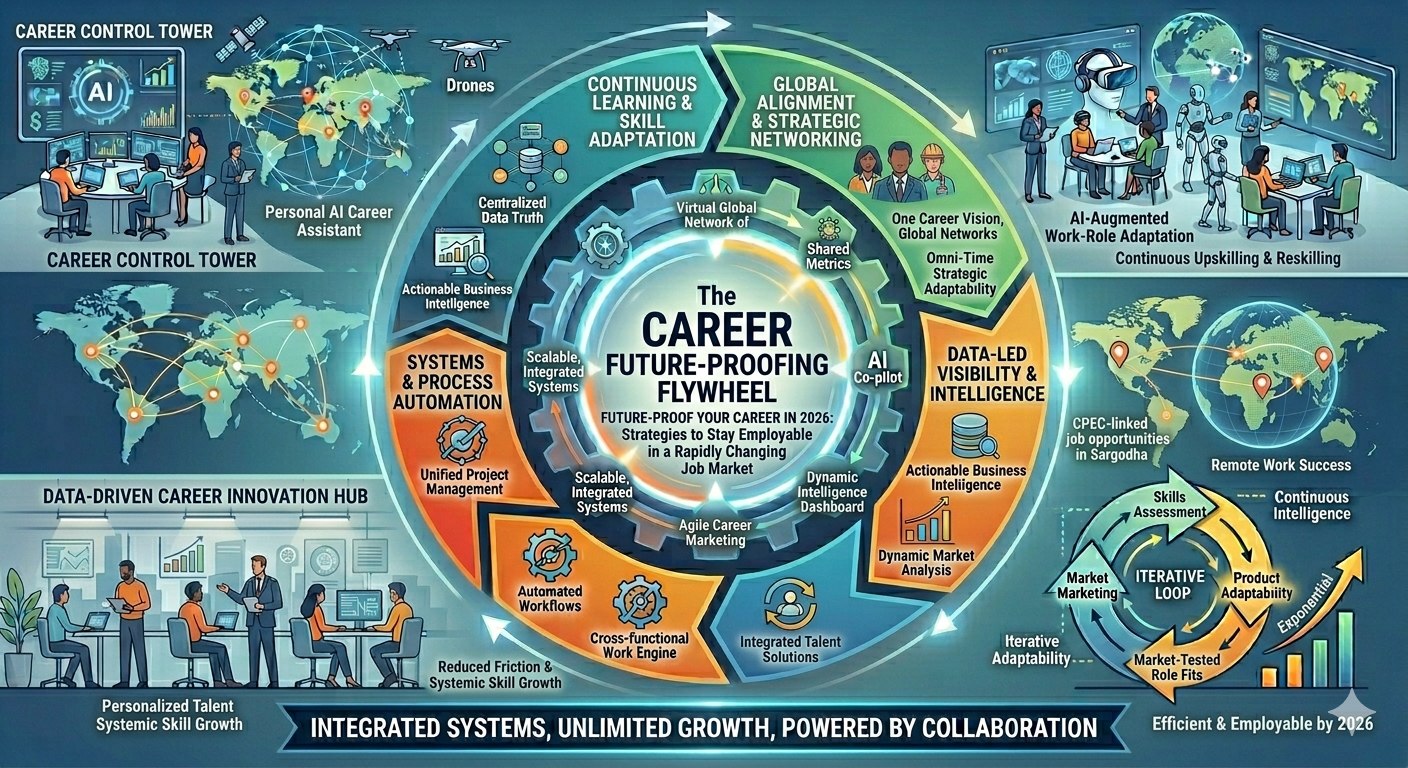
This guide explores practical strategies to future-proof your career in 2026 and beyond.
1. Understanding the New Job Market Reality
The modern job market is shaped by three dominant forces:
1.1 Automation and Artificial Intelligence
AI is replacing repetitive tasks across industries such as administration, customer support, data entry, and even parts of marketing and finance. However, it is also creating new roles in AI supervision, data analysis, and system optimization.
1.2 Remote and Hybrid Work Models
Companies now hire globally. Location is no longer a primary constraint. This increases competition but also expands opportunities for skilled professionals in developing countries.
1.3 Skill-Based Hiring
Degrees are becoming less important than demonstrable skills. Employers now prioritize portfolios, certifications, and real-world project experience.
2. Why Traditional Career Planning No Longer Works
In the past, career planning followed a predictable structure:
Education → Entry-level job → Promotion → Retirement
This model is now outdated. Careers in 2026 are:
- Non-linear
- Project-based
- Skill-driven
- Continuously evolving
Professionals often switch industries multiple times. For example, a marketing executive may transition into data analytics or product management based on skill development rather than formal education.
3. Core Skills That Ensure Career Survival in 2026
To remain competitive, professionals must focus on developing the following categories of skills:
3.1 Digital Literacy
Basic understanding of tools such as:
- AI tools (ChatGPT-like systems, automation platforms)
- Data dashboards (Power BI, Google Data Studio)
- CRM systems
- Cloud-based collaboration tools
3.2 Analytical Thinking
Companies increasingly value employees who can:
- Interpret data
- Identify trends
- Make data-driven decisions
3.3 Communication Skills
Clear communication remains critical, especially in remote teams. This includes:
- Written communication
- Virtual presentation skills
- Cross-cultural communication
3.4 Adaptability and Learning Agility
The ability to quickly learn new systems, tools, and processes is now a core employability factor.
4. The Role of AI in Career Development
AI is no longer optional in the workplace—it is foundational.
4.1 AI as a Career Multiplier
Professionals using AI tools can:
- Complete tasks faster
- Improve decision-making
- Enhance productivity
- Automate repetitive work
4.2 AI-Resistant Career Strategy
Instead of competing with AI, professionals should:
- Focus on strategic thinking roles
- Develop creativity-based skills
- Learn to manage AI systems
4.3 Emerging AI Job Roles
Some of the fastest-growing roles include:
- AI prompt engineers
- Automation specialists
- Data ethicists
- AI operations managers
5. Building a Skill-Based Career Portfolio
A traditional CV is no longer enough. Employers want proof of capability.
5.1 What is a Career Portfolio?
A career portfolio includes:
- Completed projects
- Case studies
- Certifications
- Freelance work
- Real-world results
5.2 Why It Matters
A portfolio demonstrates actual performance rather than theoretical knowledge.
For example:
Instead of saying “I know digital marketing,” a portfolio shows:
- Campaign results
- Traffic growth metrics
- Conversion improvements
6. Remote Work and Global Job Competition
Remote work has expanded the job market globally. This means:
6.1 Increased Opportunities
You can work for companies in:
- Europe
- Middle East
- North America
- Southeast Asia
6.2 Increased Competition
You are now competing with:
- Global talent pools
- Freelancers worldwide
- AI-augmented professionals
6.3 How to Compete Effectively
- Build niche expertise
- Specialize instead of generalizing
- Strengthen online professional presence
- Maintain strong English communication skills
7. High-Growth Industries in 2026
Certain industries are experiencing rapid expansion:
7.1 Technology and Software
- AI development
- Cybersecurity
- Cloud computing
- SaaS platforms
7.2 Healthcare and Biotechnology
- Medical data analysis
- Telemedicine systems
- Genetic research
7.3 Logistics and Supply Chain
- Smart logistics systems
- Automation in warehousing
- Predictive supply chain analytics
7.4 Digital Marketing and E-commerce
- Performance marketing
- Content automation
- AI-driven advertising systems
8. How Employers Are Changing Hiring Practices
Recruitment strategies are evolving significantly.
8.1 AI-Based Screening
Companies now use AI to:
- Filter CVs
- Rank candidates
- Analyze skill compatibility
8.2 Behavioral Assessments
Employers increasingly test:
- Problem-solving ability
- Decision-making under pressure
- Communication style
8.3 Remote Interview Systems
Virtual hiring is now standard, often including:
- Recorded video interviews
- AI-assisted evaluation
- Skill-based testing platforms
9. How to Stay Relevant Long-Term
Career longevity depends on continuous improvement.
9.1 Continuous Learning
Commit to learning every 3–6 months:
- New tools
- Industry trends
- Certifications
9.2 Networking Strategy
Build professional relationships via:
- Industry forums
- Remote communities
9.3 Personal Branding
Develop an online identity:
- Share insights
- Publish articles
- Showcase work publicly
10. Mistakes That Lead to Career Obsolescence
Many professionals become outdated due to avoidable mistakes:
- Ignoring new technologies
- Relying only on degrees
- Avoiding online platforms
- Lack of portfolio development
- Resistance to remote work models
Avoiding these mistakes is essential for long-term employability.
11. Practical 90-Day Career Upgrade Plan
To start future-proofing your career immediately:
First 30 Days:
- Identify skill gaps
- Select one high-demand skill
- Start basic online learning
Next 30 Days:
- Build small projects
- Create portfolio samples
- Start LinkedIn optimization
Final 30 Days:
- Apply for jobs or freelance work
- Improve CV with real projects
- Expand professional network
Conclusion
The job market in 2026 is highly competitive, but also full of opportunity. Success is no longer defined by degrees or job titles—it is defined by adaptability, skills, and continuous learning.
Professionals who embrace AI, develop strong digital capabilities, and build demonstrable portfolios will remain highly employable regardless of industry shifts.
The future belongs to those who evolve with it.