
Finding the right job is rarely about submitting one application and waiting for a response. The employment market moves continuously, with new vacancies appearing, recruitment requirements changing and employers looking for candidates with different skills and experiences.
For job seekers, staying informed and taking consistent action can make the difference between discovering a suitable opportunity and overlooking it.
An active job search involves more than browsing vacancies occasionally. It means regularly exploring available positions, updating your professional profile, improving your application materials and responding to relevant opportunities.
Whether you are a recent graduate, an experienced professional or someone considering a career change, developing a consistent job search routine can help you approach your next career move with greater confidence.
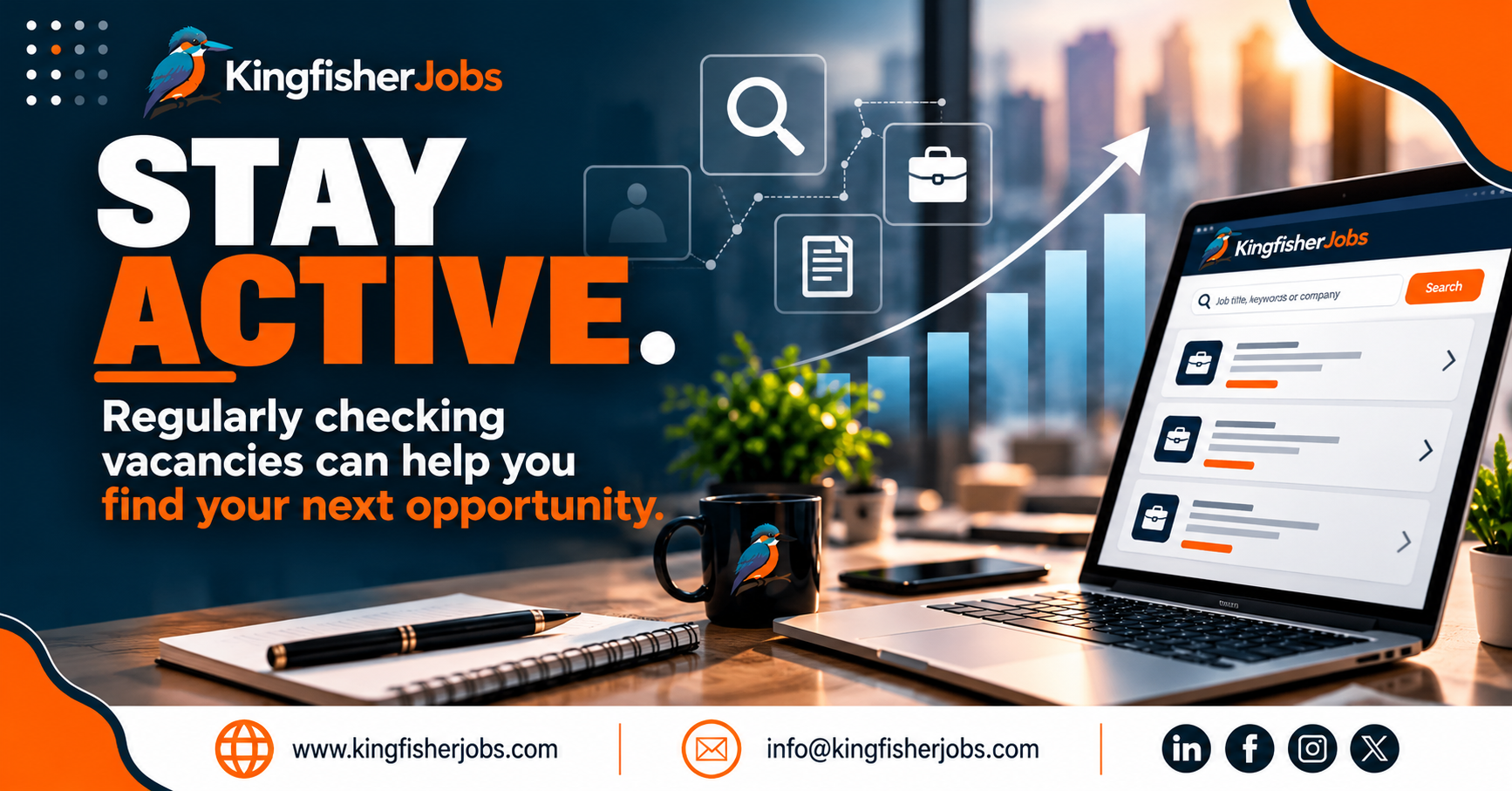
At KingfisherJobs, the message is clear: Stay Active. Regularly checking vacancies can help you find your next opportunity.
In this guide, we explore practical strategies for maintaining an effective job search, identifying suitable vacancies, improving your applications and making meaningful progress towards your career goals.
What Is an Active Job Search?
An active job search is a structured approach to finding employment opportunities through regular research, applications, professional networking and career preparation.
Rather than waiting for suitable vacancies to appear, active job seekers take responsibility for exploring opportunities and preparing themselves to apply.
This approach may include:
- Checking relevant job vacancies regularly.
- Searching across different industries and job categories.
- Updating CVs and professional profiles.
- Researching potential employers.
- Applying for suitable positions.
- Developing relevant professional skills.
- Connecting with recruiters and industry professionals.
- Preparing for interviews.
- Reviewing applications and adjusting job search strategies.
An effective job search is not necessarily about spending several hours every day submitting applications.
It is about using your available time productively and focusing on opportunities that match your qualifications, interests and professional objectives.
Why Staying Active in Your Job Search Matters
Employment opportunities can change quickly. Some vacancies remain available for several weeks, while others may close sooner depending on employer requirements and the number of applications received.
Regularly reviewing job opportunities can help candidates stay informed about available positions.
1. Discover New Vacancies
Employers advertise positions at different times throughout the week.
Checking job listings consistently increases your awareness of newly advertised opportunities.
2. Identify Relevant Career Options
Exploring vacancies can introduce you to job titles, industries and career paths you may not have considered previously.
3. Understand Employer Expectations
Job descriptions provide useful information about qualifications, technical skills, responsibilities and professional experience.
Reviewing these requirements helps you understand what employers are seeking.
4. Improve Application Readiness
An active search encourages you to keep your CV and supporting documents updated.
This can make it easier to respond when a suitable vacancy becomes available.
5. Maintain Career Momentum
Consistent, manageable action can help you stay organised and focused during a job search.
However, it is important to balance your efforts with rest and realistic expectations.
1. Check Job Vacancies Regularly
One of the simplest ways to maintain an active job search is to establish a routine for reviewing vacancies.
New positions may appear at any time, and checking periodically helps you identify opportunities that match your career goals.
Create a Job Search Schedule
Choose a schedule that fits your circumstances.
For example, you might dedicate 20–30 minutes on weekdays to reviewing suitable vacancies.
If you are currently employed, a few focused sessions each week may be more practical.
The objective is consistency rather than constant monitoring.
Use Relevant Search Terms
Search using job titles, skills, industries and locations.
For example, someone interested in marketing could explore terms such as:
- Digital Marketing Executive
- Marketing Coordinator
- Social Media Specialist
- Content Marketing Assistant
- SEO Executive
Using related job titles can help you discover roles that may not appear under your preferred title.
Review Job Descriptions Carefully
Before applying, examine the responsibilities, qualifications, location and employment arrangements.
This helps you avoid spending time on roles that do not align with your circumstances.
Save Relevant Opportunities
Maintain a shortlist of positions you want to investigate further.
Where a job platform supports saved searches or vacancy alerts, these features can help organise your search.
2. Define Your Career Goals Before Applying
An active job search becomes more effective when you understand what you want from your next role.
Without clear objectives, it can be tempting to apply for many unrelated positions.
Identify Your Preferred Industry
Consider the sectors that interest you and where your skills may be valuable.
You might explore technology, finance, healthcare, logistics, education, marketing or other professional fields.
Determine Your Preferred Role
Think about the responsibilities you enjoy and the work you want to develop further.
Consider Your Experience Level
Look for positions that reasonably match your experience, while remaining open to roles where transferable skills are relevant.
Review Practical Requirements
Consider location, salary expectations, working arrangements and career development opportunities.
Set Realistic Objectives
For example, your weekly objective might be to identify five suitable vacancies, research three employers and submit two carefully prepared applications.
These are illustrative targets, not requirements. Adjust them to the availability of relevant opportunities.
3. Keep Your CV Updated and Professional
Your CV is often one of the first documents an employer reviews.
A clear, relevant CV helps recruiters understand your qualifications, experience and suitability for a position.
Include Accurate Contact Information
Provide a professional email address and suitable contact details.
Write a Focused Professional Summary
Briefly explain your experience, key skills and the type of work you are seeking.
Highlight Relevant Experience
Describe previous responsibilities and achievements that relate to the vacancy.
Demonstrate Your Skills
Include technical, professional and transferable skills where appropriate.
Use Clear Formatting
Organise information using readable headings and consistent formatting.
Tailor Your CV to the Vacancy
Different roles may require different skills.
Adjust the emphasis of your CV to reflect the genuine requirements of each position.
Important: Never exaggerate qualifications, invent experience or include achievements you cannot substantiate.
A truthful and well-structured CV provides a stronger foundation for professional credibility.
4. Focus on Quality Applications Rather Than Quantity
Submitting a large number of applications does not automatically improve your chances of receiving an interview.
Applications are more useful when they clearly demonstrate why you are suitable for a particular position.
Read the Requirements
Identify the essential and desirable criteria.
Match Your Experience to the Role
Highlight relevant responsibilities, skills and achievements.
Prepare a Relevant Cover Letter
When a cover letter is requested or likely to add value, explain your interest in the position and how your experience relates to the employer’s needs.
Follow Application Instructions
Some employers request specific documents, questions or application formats.
Follow these requirements carefully.
Review Before Submitting
Check spelling, grammar, dates and contact information.
Make sure you have attached the correct documents.
A thoughtful application can help employers understand your suitability more easily.
5. Explore Different Industries and Career Opportunities
A successful job search may involve looking beyond familiar job titles or industries.
Many professional skills can be applied in different sectors.
Identify Transferable Skills
Transferable skills are abilities that can be valuable across multiple roles.
Examples include:
- Communication.
- Problem-solving.
- Customer service.
- Organisation.
- Project coordination.
- Data analysis.
- Teamwork.
- Time management.
- Leadership.
Research Related Positions
A customer service professional might explore customer success, account coordination or administrative roles.
A marketing assistant might consider content creation, digital communications or campaign support.
Understand Additional Requirements
Some career changes require formal qualifications, specialist training or practical experience.
Review these requirements before committing to a new direction.
Remain Open to Suitable Opportunities
Exploring related career paths can help you discover options that better match your strengths and interests.
6. Use Job Search Platforms Effectively
Online recruitment platforms make it easier to discover advertised vacancies and compare opportunities.
However, effective searching requires more than entering a job title.
Use Search Filters
Where available, filter vacancies by:
- Job title.
- Location.
- Industry.
- Employment type.
- Experience level.
- Salary range.
- Remote, hybrid or on-site arrangements.
Try Different Keywords
Employers may use different titles for similar positions.
Experiment with alternative search terms.
Check Vacancy Dates
Review publication dates and application deadlines where provided.
Research Employers
Before applying, investigate the organisation and confirm that the vacancy appears legitimate.
Keep Your Information Current
If a platform allows you to create a candidate profile, make sure your information accurately reflects your current experience and interests.
Job platforms can be valuable resources, but they should form part of a broader job search strategy.
7. Build a Strong Professional Online Presence
Recruiters and employers may review publicly available professional information when evaluating candidates.
A clear and accurate online presence can support your job search.
Update Your Professional Profile
Ensure your job title, experience, qualifications and skills are current.
Use a Clear Professional Headline
Describe your expertise or intended career direction.
Highlight Relevant Achievements
Provide concise examples of work, projects or professional accomplishments.
Share Industry-Relevant Insights
Where appropriate, contribute thoughtfully to professional discussions.
Maintain Consistency
Your CV and professional profiles should present accurate and reasonably consistent information.
You do not need to share personal information publicly to demonstrate professional competence.
8. Develop Skills That Improve Your Employability
Job descriptions can help you identify skills that employers frequently request.
Use this information to guide professional development.
Identify Skill Gaps
Compare your existing abilities with the requirements of roles that interest you.
Prioritise Relevant Learning
Focus on skills that are likely to be useful for your target positions.
Explore Suitable Learning Resources
Depending on your career goals, learning options may include online courses, workshops, professional training or practical projects.
Apply What You Learn
Practical experience can help demonstrate understanding.
For example, someone learning digital marketing might create a sample content strategy or analyse a practice campaign.
Document Genuine Achievements
Include completed projects, relevant qualifications and demonstrable skills in your professional materials.
Continuous learning can strengthen career readiness, but not every course or certificate will be equally valuable to every employer.
9. Make Professional Networking Part of Your Job Search
Not every career opportunity begins with a public job advertisement.
Professional relationships can help you learn about industries, organisations and potential career paths.
Connect With Relevant Professionals
Build connections with colleagues, recruiters, former classmates and people working in your preferred industry.
Participate in Professional Discussions
Engage respectfully in conversations that relate to your interests.
Attend Relevant Events
Industry events, career fairs and professional webinars may provide opportunities to learn and connect.
Ask for Career Advice
People with relevant experience may offer useful perspectives on qualifications, recruitment processes or career development.
Maintain Genuine Relationships
Networking should not focus exclusively on asking for jobs.
Professional relationships are more meaningful when based on mutual respect and authentic communication.
10. Prepare for Interviews Before Receiving an Invitation
Interview preparation is an important part of maintaining an active job search.
Preparing in advance can reduce last-minute pressure.
Research the Employer
Understand the organisation’s activities, products or services and the responsibilities of the advertised role.
Review Common Interview Questions
Prepare to discuss your experience, skills, achievements and career goals.
Develop Relevant Examples
Use genuine examples to demonstrate how you have handled responsibilities or challenges.
The STAR method can help structure responses:
Situation: Explain the context.
Task: Describe your responsibility.
Action: Explain what you did.
Result: Describe the outcome.
Prepare Questions
Consider asking about the role, team structure, expectations and development opportunities.
Practise Professional Communication
Focus on clear, relevant answers rather than memorising rigid scripts.
11. Track Your Job Applications
Applying for multiple positions can become confusing without an organised system.
A simple application tracker can help you manage your progress.
Record information such as:
- Employer name.
- Job title.
- Vacancy source.
- Application date.
- Closing date, if provided.
- Current application status.
- Interview details.
- Relevant follow-up notes.
You can use a spreadsheet, notebook or another suitable organisational tool.
Why Application Tracking Helps
Tracking prevents duplicate applications, reduces missed deadlines and helps you review your progress.
It can also reveal patterns.
For example, if you receive very few interview invitations despite applying for suitable positions, reviewing your CV and application approach may be worthwhile.
12. Follow Up Professionally After Applying
Following up may be appropriate when an employer has provided a contact method or indicated that enquiries are welcome.
However, follow-up expectations vary between organisations.
Respect the Recruitment Process
Read the vacancy instructions before contacting the employer.
Allow Reasonable Time
Avoid sending repeated messages shortly after applying.
Keep Communication Concise
If you do follow up, briefly identify the role and ask politely whether an update is available.
Avoid Excessive Contact
Repeated or unsolicited communication may be counterproductive.
Continue Exploring Opportunities
Do not suspend your entire job search while waiting for one response.
Maintain your broader strategy unless you have accepted an offer or have another reason to stop searching.
13. Stay Motivated During Your Job Search
Searching for employment can involve uncertainty, rejection and periods without responses.
Maintaining a balanced approach can help you continue making progress.
Set Manageable Goals
Break the process into practical weekly activities.
Recognise Progress
Updating your CV, developing a skill or completing a strong application are useful steps, even when they do not immediately result in an offer.
Avoid Constant Comparison
Different candidates have different circumstances, qualifications and opportunities.
Take Regular Breaks
Spending every available hour searching may reduce concentration and motivation.
Seek Constructive Feedback
Where available, feedback can help you improve future applications.
Review Your Strategy
If your approach is not producing results, consider whether your target roles, application materials or search methods need adjustment.
An active job search should be sustainable rather than exhausting.
14. Common Job Search Mistakes to Avoid
Several common habits can reduce the effectiveness of a job search.
Applying Without Reading the Description
This can result in applications for unsuitable positions.
Using the Same CV for Every Vacancy
A generic CV may not clearly demonstrate the most relevant skills.
Ignoring Application Deadlines
Late applications may not be considered.
Searching Only One Job Title
Narrow searches can overlook related opportunities.
Neglecting Interview Preparation
Poor preparation may make it difficult to communicate your suitability.
Failing to Research Employers
Research helps candidates make informed decisions and identify potential warning signs.
Overlooking Recruitment Scams
Be cautious about requests for unusual payments, sensitive personal information or financial details.
Verify employer identities and use trusted application channels.
Giving Up Too Early
Recruitment processes vary, and delays do not necessarily indicate a candidate’s lack of ability.
A structured approach can help you make adjustments rather than abandoning your search.
15. A Practical Weekly Job Search Routine
Creating a simple weekly plan can make your job search more organised.
The following schedule is an example that can be adapted to your circumstances.
| Day | Suggested Activity |
|---|---|
| Monday | Review newly advertised vacancies and shortlist relevant roles. |
| Tuesday | Tailor your CV and prepare applications. |
| Wednesday | Research employers and explore related career opportunities. |
| Thursday | Develop relevant skills and update professional profiles. |
| Friday | Submit outstanding applications and review progress. |
| Weekend | Reflect on your strategy, prepare for interviews and take time to rest. |
The purpose of this routine is to establish consistency.
It is not necessary to apply for jobs every day, particularly when few suitable vacancies are available.
Focus on meaningful activity rather than meeting arbitrary application targets.
16. How to Recognise the Right Career Opportunity
Not every available vacancy will be the right fit.
Before applying or accepting an offer, consider several factors.
Role Responsibilities
Do the daily tasks align with your interests and abilities?
Skills and Qualifications
Can you meet the essential requirements, or is the employer open to transferable skills and development?
Career Development
Does the position provide opportunities to build relevant experience?
Workplace Expectations
Are the working arrangements and responsibilities suitable for your circumstances?
Compensation and Benefits
Does the overall package meet your practical needs and expectations?
Organisational Credibility
Can you verify the employer and understand the terms of the opportunity?
Considering these factors helps you approach career decisions thoughtfully.
KingfisherJobs: Stay Active and Keep Exploring Career Opportunities
The KingfisherJobs campaign, Stay Active, highlights an important principle for job seekers: regularly checking vacancies can help you discover your next opportunity.
The message encourages candidates to remain engaged with their career development rather than relying on occasional searches.
Three practical ideas support this approach.
Stay Informed
Review available vacancies and remain aware of changing employment opportunities.
Stay Prepared
Keep your CV, professional information and relevant skills up to date.
Stay Proactive
Explore suitable roles, submit thoughtful applications and continue developing your professional network.
These actions help job seekers maintain direction and respond when relevant opportunities arise.
The aim is not to rush into any available position.
It is to make informed career decisions while remaining open to suitable opportunities.
Conclusion: Stay Active and Take the Next Step in Your Career
An active job search is built on preparation, consistency and informed decision-making.
Regularly checking vacancies helps you discover new opportunities, understand employer expectations and remain aware of developments in your preferred industries.
At the same time, maintaining an updated CV, strengthening professional skills, preparing for interviews and tracking applications can make your overall search more effective.
Remember that finding the right opportunity may take time.
Focus on roles that align with your skills and aspirations, and use each stage of the process to improve your approach.
At KingfisherJobs, the message is simple:
Stay Active. Explore Opportunities. Take the Next Step.
Whether you are entering the workforce, seeking career progression or exploring a new professional direction, staying informed can help you prepare for what comes next.
Ready to explore your next career opportunity?
Visit www.kingfisherjobs.com to explore KingfisherJobs.
For enquiries, contact info@kingfisherjobs.com.
Stay active today. Your next career opportunity could be worth discovering.