
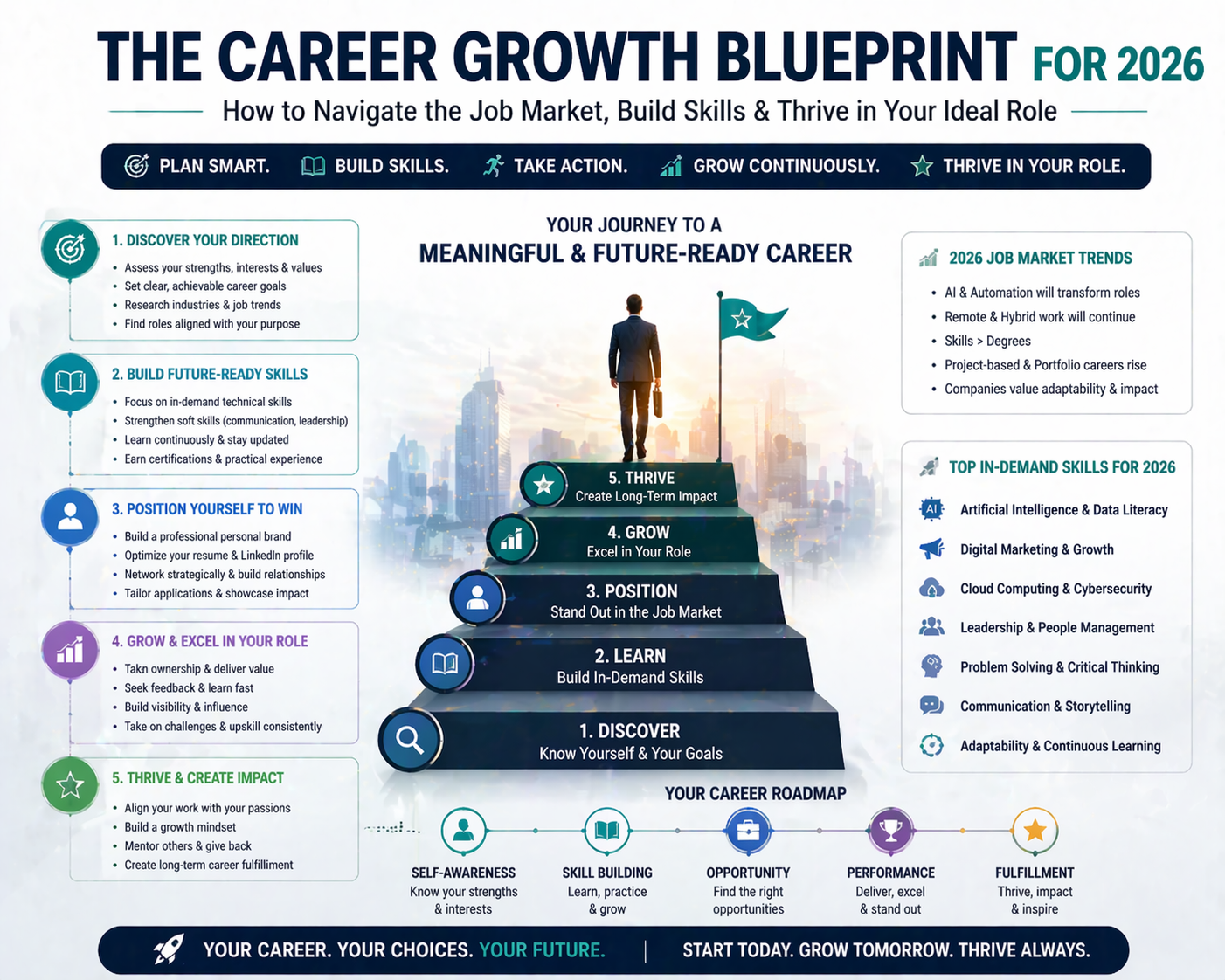
Introduction — The Job Market in 2026
As we move deeper into 2026, the job market continues to evolve at an accelerated pace. Automation, artificial intelligence, remote and hybrid work models, and new industry paradigms (from sustainability to digital services) are all altering what it means to find, secure, and grow in a career. Traditional resumes and one‑time skill sets no longer guarantee success. Today’s career trajectory requires strategic planning, continual skill development, personal branding, and the ability to adapt with market trends.
This article is a complete career growth blueprint for professionals at any stage — entry, mid, or senior level. You’ll learn how to:
- Understand the current job market landscape
- Define personal career goals with clarity
- Build high‑value skills that employers want
- Create a personal brand that stands out
- Master the application and interview process
- Negotiate offers with confidence
- Navigate career progression once hired
- Leverage networking, mentorship, and community
- Plan for long‑term career growth and fulfillment
Whether you’re just entering the workforce or aiming for your next career breakthrough, this blueprint will give you clarity, structure, and actionable steps to transform your professional journey in 2026.
1. Understanding the 2026 Job Market
The labor market in 2026 is shaped by technological innovation, globalization, and evolving organizational needs. Here are key trends:
1.1 Tech‑Enabled Roles Are Growth Leaders
Many sectors — from finance to healthcare — increasingly demand digital fluency. Jobs in:
- Data analytics
- Cloud computing
- Digital marketing
- UX/UI design
- Automation and AI support
- Cybersecurity
…are among the fastest growing and most resilient.
These roles reward both foundational technical skills and the ability to communicate insights clearly.
1.2 Remote & Hybrid Work Are Standard
Remote and hybrid roles are no longer exceptions — they are mainstream. Employers now expect candidates to:
- Work independently
- Communicate asynchronously
- Use remote collaboration tools
- Demonstrate time‑management discipline
Understanding remote work norms will help you compete effectively.
1.3 Soft Skills Are Strategic Differentiators
While technical skills open doors, soft skills win interviews and advance careers:
- Communication
- Problem‑solving
- Critical thinking
- Collaboration
- Adaptability
These skills differentiate top performers from good ones.
2. Defining Your Career Vision
Before launching into applications, you must define your destination — a clear career vision.
2.1 What Does Career Success Look Like for You?
Answer these:
- What motivates you professionally?
- What kind of work energizes you?
- Where do you see yourself in 3–5 years?
- What industry or role excites you most?
Write a short career vision statement now. Example:
I aim to become a data‑driven marketing strategist who helps brands grow online, achieving leadership responsibility within three years while developing a community of learners around marketing best practices.
This statement becomes your career compass.
2.2 Set SMART Career Goals
Use SMART goals:
- Specific — What exact role or skill?
- Measurable — How will you track progress?
- Achievable — Is it realistic yet challenging?
- Relevant — Does it align with your vision?
- Time‑bound — What’s the deadline?
Example:
Achieve a marketing analytics certification and build a portfolio of 5 case studies by December 2026.
SMART goals transform vague ambition into measurable actions.
3. Skill Building — Future‑Ready Skills That Matter
Employers are targeting candidates with capabilities, not just degrees. Your goal is to build a T‑shaped skill profile:
- A strong depth in your core area
- A broad base of complementary skills
3.1 Core Skills Employers Demand
Digital Literacy:
Basic comfort with digital tools — from spreadsheets to analytics platforms.
Communication:
Clear writing, persuasive messaging, and effective presentations.
Problem Solving:
Structured thinking and the ability to generate solutions.
Project Planning:
Managing tasks, timelines, and deliverables.
Collaboration:
Working effectively with diverse teams.
Develop these through real projects — not only courses.
3.2 Technical & Specialized Skills
Depending on your field, you may need specialized competencies:
| Field | Skills in Demand |
|---|---|
| Tech | Python, SQL, Cloud Platforms |
| Marketing | SEO, Analytics, Automation |
| Finance | Financial Modeling, Power BI |
| Design | Figma, UX Research |
| Operations | Lean, Agile Methods |
| HR | Talent Analytics, DEI Strategy |
Identify 2–3 high‑impact skills and master them deeply. Surface knowledge won’t differentiate you.
3.3 Build a Skills Portfolio
Rather than just listing courses, show your work. Build a portfolio that contains:
- Projects you completed
- Data you analyzed
- Campaigns you designed
- Reports you authored
- Code or design work
Employers value portfolios because they show what you can do, not just what you learned.
4. Personal Branding — Stand Out in a Crowded Market
Your resume is no longer your first introduction — your digital presence often is.
4.1 Optimize Your LinkedIn Profile
Your LinkedIn should:
- Have a professional photo
- Include a compelling headline (skill + impact)
- Contain a well‑written summary
- Showcase achievements, not duties
- Include recommendations
Your profile must communicate value and direction.
4.2 Thought Leadership & Content Creation
Create content that:
- Solves problems in your niche
- Answers common questions
- Shares your learning journey
- Highlights trends and insights
Platforms:
- LinkedIn Publishing
- Personal blog
- Medium
- YouTube or Reels
Thought leadership increases visibility and establishes credibility.
4.3 Digital Business Card — Your Professional Identity Online
Your digital business card should include:
- LinkedIn profile
- Portfolio or personal website
- Selected project links
- Professional email
This makes you findable and credible.
5. The Job Search Playbook — Strategy, Research & Targeting
A successful job search is intentional — not scattershot.
5.1 Identify Roles That Fit Your Strategy
Filter roles based on:
- Skill alignment
- Industry interest
- Growth trajectory
- Work model (remote/hybrid/in‑office)
Don’t apply to every job — apply to roles that fit your vision and value proposition.
5.2 Research Companies Thoroughly
Before applying:
- Study their mission and culture
- Understand their products and customers
- Read recent news and growth signals
- Identify their challenges
This prepares you for tailored applications and interviews.
6. Resume & Cover Letter — Precision Messaging for Impact
Your resume and cover letter must communicate value first.
6.1 Resume Tips for 2026
Focus on Impact: Write achievements, not duties.
Example:
Increased email engagement by 37% through segmented campaigns, contributing to a 12% revenue lift.
Use Metrics: Numbers make impact concrete.
Tailor for Keywords: Many systems scan resumes for keywords.
6.2 Cover Letter as a Strategic Argument
Cover letters should:
- Be personal and specific
- Reference company mission
- Show fit between skills and role
- Include one strong example of impact
Avoid generic, copy‑paste letters.
6.3 ATS‑Friendly Formatting
Use:
- Simple fonts
- Clear headings
- No images or complex layouts
Ensure your resume parses well with applicant tracking systems.
7. Nailing the Interview — Preparation & Strategy
Interviews are where rhetoric meets proof.
7.1 Research & Practice
Research:
- The interviewer’s background
- The company’s products and competitors
- Recent news or relevant trends
Practice:
- Behavioral questions (STAR method)
- Case or skills tests
- Portfolio walk‑through
Confidence comes from preparation.
7.2 STAR Method for Behavioral Responses
Structure your answers:
- Situation: What was happening?
- Task: What was your responsibility?
- Action: What did you do?
- Result: What changed?
This framework ensures clarity and impact.
7.3 Ask Better Questions
Good questions show curiosity and strategic thinking:
- What are the team’s key priorities this quarter?
- How is success measured in this role?
- What skill areas do you see as most critical next year?
Avoid generic, closed questions.
8. Salary Negotiation — Ask for What You’re Worth
Negotiation is a skill and a strategy.
8.1 Do Your Market Research
Use:
- Industry salary benchmarks
- Location‑adjusted ranges
- Company size and growth signals
Know the range before you negotiate.
8.2 Frame Negotiation in Value, Not Need
Instead of: “I need more money.”
Say:
“Given my experience and the business impact I’ll drive, I’d like to explore a base salary closer to X.”
This positions you as informed and strategic.
8.3 Consider Total Compensation
Include:
- Bonus structure
- Stock or equity
- Benefits and perks
- Learning stipends
- Wellness and flexibility allowances
Sometimes non‑base compensation adds significant value.
9. Thriving in Your First 90 Days — Strategy & Impact
Getting hired is the first step — thriving is the rest.
9.1 Build Early Credibility
In your first 90 days:
- Listen before proposing big changes
- Understand team norms and priorities
- Achieve quick wins
- Establish clear goals with your manager
Quick wins create momentum.
9.2 Set Personal KPIs
Identify key result areas that align with team success:
- Deliverables completed
- Quality improvements
- Relationship building
- Stakeholder feedback
Track them daily and weekly.
9.3 Seek Feedback Actively
Ask:
- What can I improve?
- Are my priorities aligned with team goals?
This accelerates your growth curve.
10. Long‑Term Career Growth — Planning Beyond the First Job
Career growth is continuous.
10.1 Build a Learning Roadmap
Continually upskill:
- New certifications
- Workshops
- Industry events
- Masterminds and peer groups
Learning keeps you future‑ready.
10.2 Networking as a Growth Lever
Network strategically:
- Industry events and conferences
- Digital professional communities
- Mentorship and advisory relationships
Networks open doors you never expected.
10.3 Personal Brand Evolution
Your brand evolves with your experience:
- New portfolio pieces
- Speaking engagements
- Authored articles
- Social thought leadership
A strong personal brand multiplies opportunities.
11. Resilience & Mindset — The X‑Factor in Career Success
Careers aren’t linear. Resilience matters.
11.1 Rejection Is Data, Not Defeat
Every no brings insight:
- Timing mismatch
- Skills gap
- Cultural misalignment
Use feedback to refine your approach.
11.2 Intentional Career Reflection
Set quarterly reflection checkpoints:
- What worked?
- What didn’t?
- What do I want next?
Reflection drives intentional growth.
Conclusion — Your Career Growth Engine Starts Today
The job market in 2026 rewards those who plan, adapt, learn, and execute with clarity. You now have a comprehensive roadmap covering:
✔ Market understanding
✔ Career vision and goals
✔ Skill building and portfolio development
✔ Personal branding
✔ Job search strategy
✔ Application and interviewing
✔ Negotiation and onboarding
✔ Long‑term career growth
Your career is not a ladder — it’s a strategic journey. With intention and continuous execution, you can acquire not just jobs, but opportunities that accelerate your trajectory toward professional fulfillment and impact.