

Introduction: A Major Shift in the Job Market
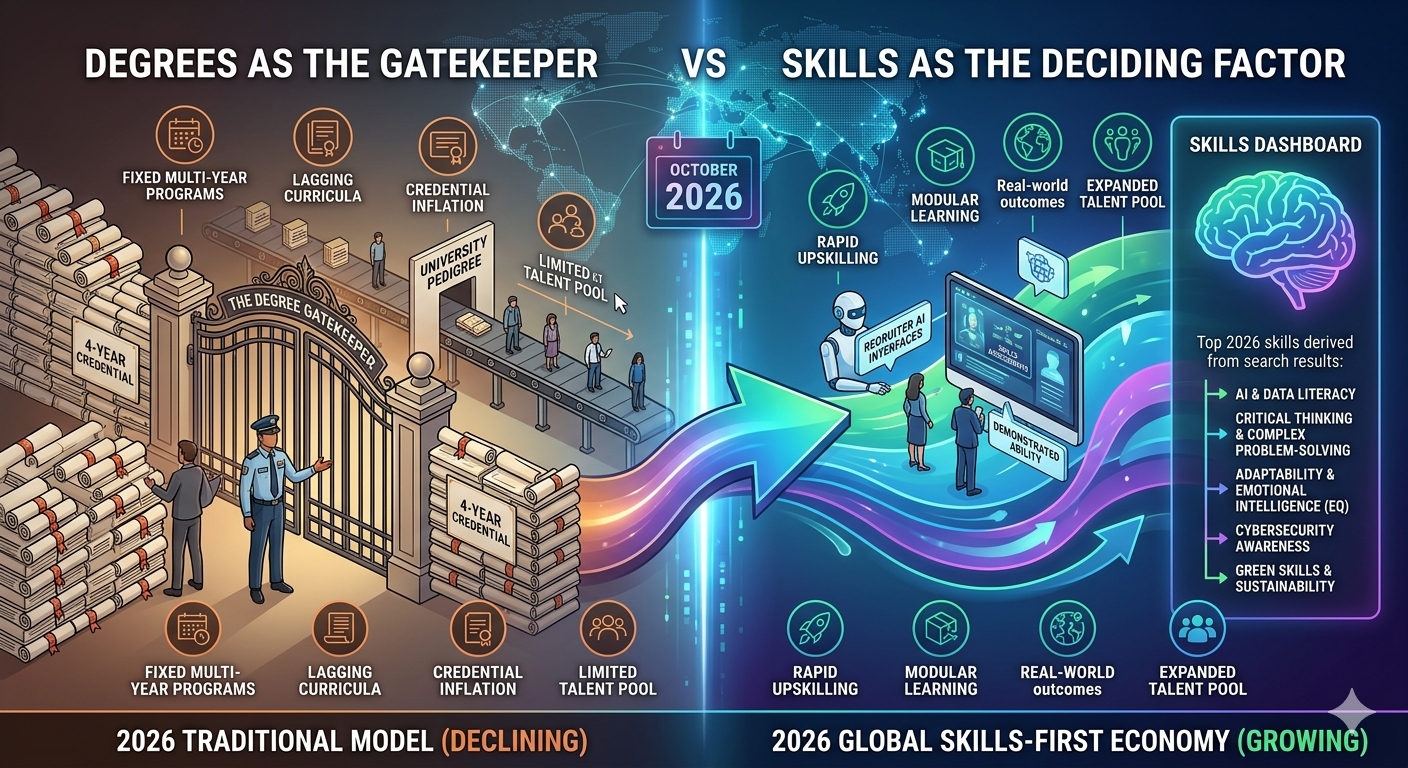
The global job market is undergoing one of the most significant transformations in modern history. For decades, academic degrees were considered the primary gateway to employment. A university certificate often determined whether a candidate was even considered for an interview.
However, in 2026, that model is rapidly losing relevance.
Companies are now prioritizing skills, adaptability, and real-world performance over formal education. Employers want people who can contribute immediately, not just those with theoretical knowledge.
This shift is not temporary. It is being driven by technology, automation, remote work culture, and changing business needs. Platforms like KingfisherJobs are emerging as part of this evolution—connecting employers directly with skilled candidates who can deliver results.
Understanding this transition is essential for job seekers, students, and professionals planning their careers.
1. Why Traditional Degree-Based Hiring Is Declining
1.1 The Over-Saturation of Degrees
Every year, millions of graduates enter the job market globally. While education levels have increased, job availability has not expanded at the same pace.
This has created a situation where:
- Many degree holders compete for the same roles
- Academic qualifications no longer guarantee job readiness
- Employers struggle to identify practical talent
As a result, companies are shifting focus toward measurable abilities.
1.2 The Gap Between Education and Industry Needs
One of the biggest problems in traditional education is the gap between what is taught and what is required in real workplaces.
For example:
- Marketing students may study theory but lack digital ad experience
- IT graduates may understand concepts but struggle with real project deployment
- Business students may not be familiar with modern tools like CRM systems or analytics platforms
Employers today prefer candidates who already understand tools like:
- Google Analytics
- CRM platforms (HubSpot, Salesforce)
- Project management tools (Asana, Trello)
- AI-based productivity tools
1.3 Rising Cost of Hiring Mistakes
Hiring the wrong person is expensive. Companies lose time, money, and productivity when employees cannot perform as expected.
Skill-based hiring reduces this risk because:
- Candidates are tested on real abilities
- Work samples or portfolios are reviewed
- Performance is more predictable
2. What Skill-Based Hiring Actually Means
Skill-based hiring is not about ignoring education completely. Instead, it prioritizes what a candidate can do over what they studied.
It evaluates candidates based on:
- Practical experience
- Technical ability
- Problem-solving skills
- Portfolio or past work
- Certifications and short courses
This system allows employers to identify talent more accurately.
3. Industries Driving the Shift Toward Skills
3.1 Technology and IT
The tech industry was the first to adopt skill-based hiring. Programming languages, frameworks, and project portfolios matter more than degrees.
Employers look for:
- GitHub projects
- Freelance work
- Open-source contributions
- Certifications in cloud platforms
3.2 Digital Marketing
Marketing has evolved rapidly. Traditional degrees are less relevant compared to hands-on experience with:
- Social media campaigns
- SEO optimization
- Paid advertising (Meta, Google Ads)
- Content strategy
A candidate who has successfully run campaigns often gets preference over a marketing graduate with no experience.
3.3 Healthcare and Life Sciences (Selective Shift)
While degrees remain important in regulated fields, supporting roles are increasingly skill-based.
Examples:
- Medical coding specialists
- Lab technicians with certifications
- Healthcare data analysts
3.4 Sales and Customer Support
These industries prioritize communication skills, persuasion ability, and real-world performance.
Companies evaluate:
- Sales track record
- Communication clarity
- Customer handling ability
- Problem-solving in real scenarios
4. How AI and Automation Are Changing Hiring
Artificial Intelligence is reshaping recruitment at every level.
4.1 AI Resume Screening
Most companies now use AI tools to:
- Scan resumes
- Match keywords
- Rank candidates
However, this is also pushing employers to go beyond resumes and evaluate actual performance.
4.2 AI Skill Testing Platforms
Instead of interviews alone, companies use:
- Coding tests
- Scenario-based simulations
- Task completion assessments
This reduces bias and improves accuracy in hiring decisions.
4.3 Automation of Entry-Level Jobs
Routine jobs are increasingly automated. This means:
- Fewer roles for basic administrative work
- Higher demand for skilled and adaptable workers
- Greater importance of problem-solving ability
5. The Rise of Portfolio-Based Hiring
One of the strongest indicators of skill-based hiring is the importance of portfolios.
5.1 What Employers Want to See
Instead of only asking for degrees, employers now ask:
- “Show me your work”
- “What projects have you completed?”
- “Can you demonstrate results?”
5.2 Examples of Strong Portfolios
- Developers: GitHub repositories, live apps
- Designers: Behance or Dribbble profiles
- Writers: Published articles or blogs
- Marketers: Campaign reports and analytics dashboards
5.3 Why Portfolios Are More Powerful
A portfolio shows:
- Actual ability
- Problem-solving approach
- Creativity
- Consistency
This is far more reliable than academic transcripts.
6. The New Role of Degrees in 2026
Degrees are not becoming useless—they are becoming supporting credentials.
They are still valuable for:
- Medical professions
- Engineering certifications
- Law and regulated industries
- Research roles
However, for most corporate and digital jobs, degrees are now secondary.
7. Skills That Matter Most in the Modern Job Market
7.1 Digital Literacy
Basic understanding of tools like:
- Excel / Google Sheets
- Email platforms
- Online collaboration tools
7.2 Communication Skills
Clear communication is essential in:
- Remote teams
- Client interactions
- Sales and marketing
7.3 Critical Thinking
Employers value candidates who:
- Solve problems independently
- Analyze situations logically
- Make data-driven decisions
7.4 Adaptability
The ability to learn quickly is now a top hiring factor because:
- Tools change frequently
- Markets evolve rapidly
- AI is constantly reshaping workflows
8. How Job Seekers Can Prepare for This Shift
8.1 Build Real Experience Early
Even without a job:
- Freelance online
- Join internships
- Work on personal projects
8.2 Learn Industry Tools
Focus on tools relevant to your field instead of only theory.
8.3 Create a Digital Portfolio
A simple website or profile showcasing your work can significantly increase your chances.
8.4 Focus on Continuous Learning
Short courses, certifications, and self-learning are now more valuable than ever.
9. The Role of Job Platforms in Skill-Based Hiring
Modern job platforms are no longer just listing websites. They are becoming career ecosystems.
Platforms like KingfisherJobs help by:
- Connecting skilled candidates directly with employers
- Highlighting relevant job matches
- Reducing dependency on traditional recruitment agencies
- Providing career guidance content
This ecosystem supports faster and more accurate hiring decisions.
Conclusion: The Future Belongs to Skills
The global employment landscape is moving toward a simple reality:
What you can do matters more than what you studied.
Degrees will still exist, but they will no longer be the main deciding factor in most industries.
For job seekers, this shift is an opportunity. It opens doors for people who may not have formal education but possess real, practical skills.
The future job market belongs to individuals who are:
- Skilled
- Adaptable
- Experienced
- Continuously learning
Those who focus on building real abilities today will dominate the opportunities of tomorrow.