

Introduction
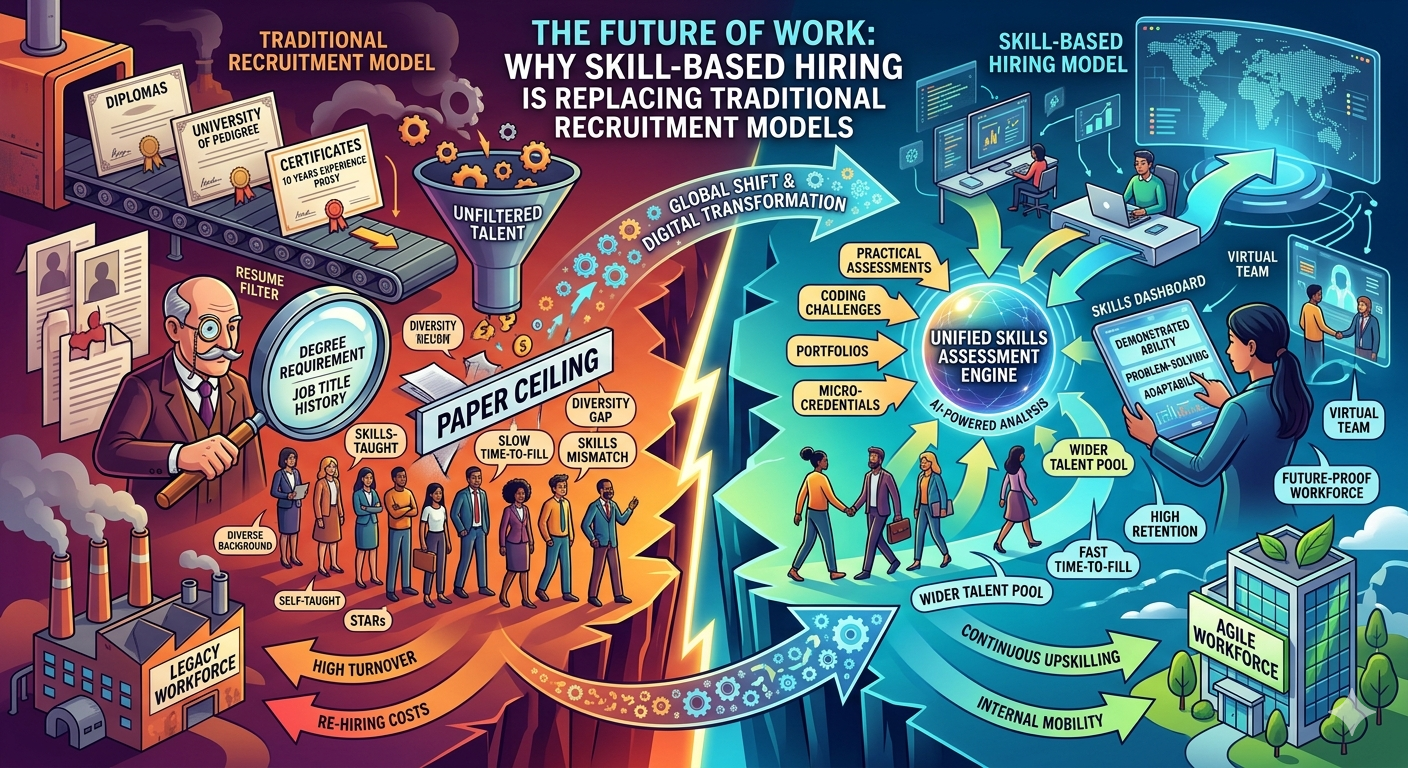
The global job market is undergoing a structural transformation. Traditional hiring models, which once prioritized academic degrees, job titles, and years of experience, are rapidly being replaced by skill-based hiring systems that focus on real-world capability, adaptability, and measurable performance.
In platforms like KingfisherJobs, where employers and job seekers connect directly, this shift is becoming increasingly visible. Companies are no longer asking only “Where did you study?” or “How many years have you worked?” Instead, they are asking a more critical question: “What can you actually do?”
This article explores the rise of skill-based hiring, the limitations of traditional recruitment, and how both employers and job seekers can adapt to this new reality.
1. The Decline of Traditional Hiring Models
For decades, recruitment followed a predictable pattern:
- Degree from a recognized institution
- Relevant job title in previous roles
- Fixed years of experience requirement
- Standard interview-based evaluation
This system worked in a slower, more predictable economy. However, modern industries—especially technology, digital marketing, and remote services—are evolving too fast for rigid hiring structures.
Key limitations of traditional recruitment:
1. Degree dependency
Many roles require degrees that are not always aligned with actual job tasks.
2. Experience bias
Candidates with less experience but higher ability are often rejected.
3. Slow hiring cycles
Traditional recruitment processes can take weeks or even months.
4. Skill mismatch
Employees often struggle in roles despite “qualified” resumes.
As industries become more dynamic, these limitations are becoming more costly for organizations.
2. What Is Skill-Based Hiring?
Skill-based hiring focuses on evaluating candidates based on their actual capabilities rather than credentials alone.
Instead of asking:
- Where did you study?
- How many years have you worked?
Employers ask:
- Can you solve this problem?
- Can you complete this task?
- Can you demonstrate this skill?
This shift emphasizes practical assessment over theoretical qualifications.
Core principles of skill-based hiring:
- Practical testing (assignments, tasks, simulations)
- Portfolio evaluation
- Real-time problem solving
- Performance-based interviews
- AI-driven skill matching systems
3. Why Companies Are Shifting Toward Skills Over Degrees
The modern workplace demands flexibility, speed, and innovation. Companies cannot afford long onboarding cycles or mismatched hires.
3.1 Faster productivity
Skill-verified candidates contribute immediately without long training periods.
3.2 Reduced hiring risk
Assessing real ability minimizes hiring mistakes.
3.3 Wider talent pool
Companies can hire globally without geographic or academic limitations.
3.4 Better job-role alignment
Employees are placed in roles that match their actual strengths.
4. The Role of Digital Job Platforms in This Shift
Platforms like KingfisherJobs are at the center of this transformation. Modern job portals are no longer just listing websites—they are evolving into intelligent talent-matching ecosystems.
Key features enabling this shift:
- Skill-tag based candidate filtering
- Automated job matching systems
- Online assessments
- Candidate dashboards with real-time updates
- Employer-side analytics
These features reduce friction between employers and candidates and increase hiring accuracy.
5. How Job Seekers Are Affected
The rise of skill-based hiring has changed the rules of career development.
5.1 Degrees are no longer enough
A degree alone is not a guarantee of employment. Employers now expect demonstrable skills.
5.2 Portfolios matter more than CVs
A strong portfolio can outweigh multiple years of formal experience.
5.3 Continuous learning is essential
Skills must be updated regularly to stay relevant in competitive industries.
5.4 Freelance and remote work opportunities are increasing
Skill-based hiring supports remote-first and gig economy roles.
6. High-Demand Skills in the Modern Job Market
Across industries, certain skills are becoming universally valuable.
6.1 Digital skills
- Social media management
- SEO and content marketing
- Data analysis
- UI/UX design
6.2 Technical skills
- Web development (HTML, CSS, JavaScript, React)
- Backend systems (PHP, Node.js, Python)
- Cloud computing
6.3 Business skills
- Project management
- Sales strategy
- Customer relationship management
6.4 Soft skills
- Communication
- Problem-solving
- Adaptability
- Critical thinking
Employers increasingly value a combination of technical and soft skills.
7. Artificial Intelligence and Automated Hiring
AI is accelerating the transition toward skill-based recruitment.
How AI is changing hiring:
- Resume parsing and skill extraction
- Automated candidate ranking
- Predictive performance analysis
- Chat-based screening interviews
- Skill gap identification
This reduces human bias and improves efficiency in hiring decisions.
However, it also means candidates must optimize their profiles for machine-readable systems.
8. Challenges of Skill-Based Hiring
Despite its advantages, this model is not without challenges.
8.1 Standardization issues
There is no universal system to measure skills consistently.
8.2 Over-reliance on testing
Practical tests may not always reflect long-term performance.
8.3 Digital divide
Candidates without access to technology may be disadvantaged.
8.4 Employer adaptation
Many organizations still rely on traditional HR practices.
9. What This Means for Employers
For companies using platforms like KingfisherJobs, the hiring process must evolve.
Recommended practices:
- Focus on role-based skill requirements
- Implement task-based interviews
- Use structured evaluation systems
- Invest in candidate skill assessment tools
- Reduce unnecessary qualification filters
This leads to better hiring outcomes and improved workforce quality.
10. What This Means for Job Platforms Like KingfisherJobs
Job portals are becoming more than listing platforms—they are becoming career intelligence systems.
Future developments may include:
- AI-driven job matching engines
- Real-time skill verification
- Automated interview scheduling
- Candidate ranking dashboards
- Career growth prediction systems
This positions platforms like KingfisherJobs as central infrastructure in the future job ecosystem.
11. The Future of Work: A Skill-First Economy
The global economy is clearly moving toward a skill-first structure.
In the next decade:
- Degrees will matter less than portfolios
- Remote hiring will become standard
- AI will handle most screening processes
- Continuous learning will become mandatory
- Skills will be treated as currency
This is not a temporary trend—it is a permanent structural change in employment systems.
Conclusion
The transition from traditional hiring to skill-based recruitment represents one of the most important shifts in the modern workforce. It is changing how companies hire, how candidates prepare, and how platforms like KingfisherJobs operate.
For job seekers, the message is clear: build skills, not just resumes.
For employers, the priority is equally clear: hire for ability, not assumptions.
As this transformation continues, platforms that successfully bridge the gap between skills and opportunities will define the future of work.