

ntroduction: The Gap Between Talent and Opportunity
In today’s digital economy, one paradox continues to exist:
There are millions of job openings.
There are millions of job seekers.
Yet, the right people still struggle to find the right opportunities—and companies struggle to find the right talent.
This is not a supply problem.
It’s a matching problem.
In 2026, hiring success is no longer about:
- Posting more jobs
- Applying to more roles
- Increasing volume
It’s about building a smart talent matching system.
Platforms like KingfisherJobs are transforming how this connection happens—making hiring faster, smarter, and more efficient across industries
Why Traditional Hiring No Longer Works
The traditional hiring process is outdated.
Old Model:
- Employers post jobs
- Candidates apply manually
- Recruiters filter applications
Problems:
1. Information Overload
Employers receive too many irrelevant applications.
2. Time Delays
Hiring cycles are slow and inefficient.
3. Poor Matching Quality
Candidates apply blindly without alignment.
4. Lack of Transparency
Both sides lack clear insights into expectations.
This leads to:
- Wasted time
- Poor hiring decisions
- Frustration on both sides
The Rise of Smart Hiring Platforms
Modern hiring platforms are changing the game.
Instead of acting as simple job boards, they function as:
- Matching systems
- Career ecosystems
- Recruitment engines
KingfisherJobs enables users to:
- Discover verified job opportunities
- Connect directly with employers
- Apply quickly and efficiently
This shift from listing-based hiring to connection-based hiring is defining the future.
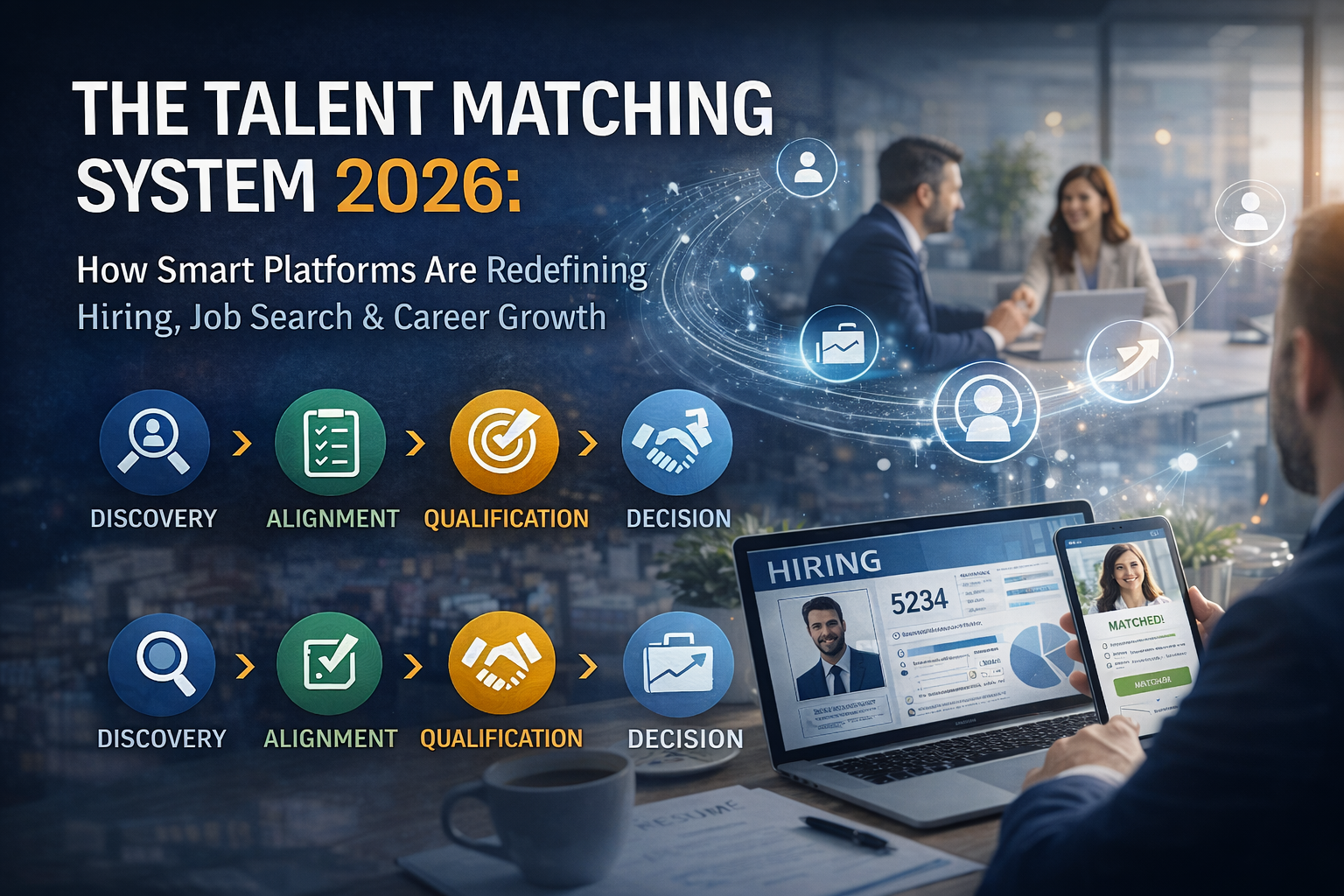
The Talent Matching System: A 5-Step Framework
To succeed in 2026, both employers and candidates must operate within a structured system.
1. Discovery
2. Alignment
3. Qualification
4. Decision
5. Growth
Each stage plays a critical role.
Stage 1: Discovery — Finding the Right Opportunities Faster
For Candidates
Job search is no longer about scrolling endlessly.
It’s about:
- Targeted searches
- Smart filters
- Relevant recommendations
Modern platforms allow candidates to:
- Search by role, location, and skills
- Explore verified companies
- Access curated opportunities
This significantly reduces time and improves accuracy.
For Employers
Discovery works both ways.
Employers must ensure their roles are discoverable.
This means:
- Clear job titles
- Accurate categories
- Relevant keywords
Visibility determines success.
Stage 2: Alignment — Matching Skills with Opportunities
This is where most hiring fails.
Mismatch leads to:
- Rejected applications
- Poor hires
- High turnover
What Alignment Looks Like
A strong match includes:
- Skills fit
- Experience relevance
- Cultural compatibility
Platforms like KingfisherJobs are designed to improve alignment by connecting candidates with roles that match their profiles
Stage 3: Qualification — Filtering for Quality
Not every applicant is the right fit.
Qualification ensures:
- Efficiency
- Accuracy
- Better outcomes
For Employers
Focus on:
- Core competencies
- Relevant experience
- Communication skills
For Candidates
Focus on:
- Tailored applications
- Highlighting key strengths
- Demonstrating value
Quality always beats quantity.
Stage 4: Decision — Turning Matches into Hires
This is the most critical stage.
Why Decisions Fail
- Slow response times
- Poor communication
- Complicated processes
Winning Strategy for Employers
- Respond quickly
- Simplify interviews
- Provide clear expectations
Winning Strategy for Candidates
- Prepare effectively
- Understand the company
- Communicate confidently
Speed and clarity drive success.
Stage 5: Growth — Beyond Hiring
Hiring is not the end.
It’s the beginning.
For Employers
Growth means:
- Retaining employees
- Developing talent
- Building strong teams
For Candidates
Growth means:
- Skill development
- Career progression
- Long-term stability
Platforms that support both hiring and career growth create long-term value.
The Role of Technology in Hiring
Technology is the backbone of modern hiring systems.
Key Innovations
1. Smart Matching Algorithms
Connect candidates with relevant jobs.
2. Automated Processes
Reduce manual work and speed up hiring.
3. Data Insights
Help both employers and candidates make better decisions.
4. Centralized Platforms
Everything in one place—search, apply, manage.
KingfisherJobs integrates these elements to streamline hiring and job search experiences
Why Speed Is the New Competitive Advantage
In 2026:
- Top candidates get hired within days
- Employers lose talent due to delays
Faster Hiring Means:
- Better candidates
- Higher acceptance rates
- Improved efficiency
Faster Job Search Means:
- More opportunities
- Less frustration
- Better career decisions
Speed is no longer optional—it’s essential.
The Power of Employer Branding
Candidates don’t just apply for jobs.
They apply for companies.
Strong Employer Branding Includes:
- Clear company identity
- Positive reputation
- Transparent communication
A strong brand attracts better candidates and improves hiring outcomes.
The Candidate Advantage: Standing Out in 2026
Candidates must compete differently.
What Works Today
- Clear CV
- Updated profile
- Skill-focused approach
What Doesn’t Work
- Generic applications
- Applying randomly
- Lack of preparation
Candidates who position themselves strategically:
- Get noticed faster
- Receive better offers
- Build stronger careers
The Biggest Hiring Mistakes to Avoid
For Employers
- Vague job descriptions
- Slow hiring process
- Ignoring candidate experience
For Candidates
- Applying without strategy
- Poor profile presentation
- Lack of preparation
Avoiding these mistakes dramatically improves outcomes.
Real-World Transformation Example
Before:
- Manual hiring process
- Low-quality applications
- Slow decisions
After:
- Platform-based hiring
- Smart matching
- Faster communication
Results:
- Better hires
- Reduced hiring time
- Improved satisfaction
Future Trends in Hiring (2026 and Beyond)
1. AI-Driven Recruitment
More accurate matching.
2. Global Talent Access
Remote hiring expands opportunities.
3. Skill-Based Hiring
Focus on abilities, not degrees.
4. Platform-Centric Hiring
Everything moves to digital platforms.
Key Metrics That Define Success
For Employers
- Time to hire
- Cost per hire
- Employee retention
For Candidates
- Interview success rate
- Offer rate
- Career growth
Tracking these metrics improves performance.
Final Thoughts: The Future Belongs to Smart Systems
Hiring and job searching are no longer manual processes.
They are systems.
Systems that:
- Match talent with opportunity
- Reduce friction
- Improve outcomes
Platforms like KingfisherJobs are leading this transformation—making hiring faster, smarter, and more effective for everyone involved
Call to Action
If you are:
An Employer
Stop relying on outdated hiring methods.
Adopt a system that attracts, filters, and converts top talent efficiently.
A Candidate
Stop applying randomly.
Focus on strategy, positioning, and smart job search platforms.
Because in 2026:
Success doesn’t come from doing more.
It comes from doing it smarter.