


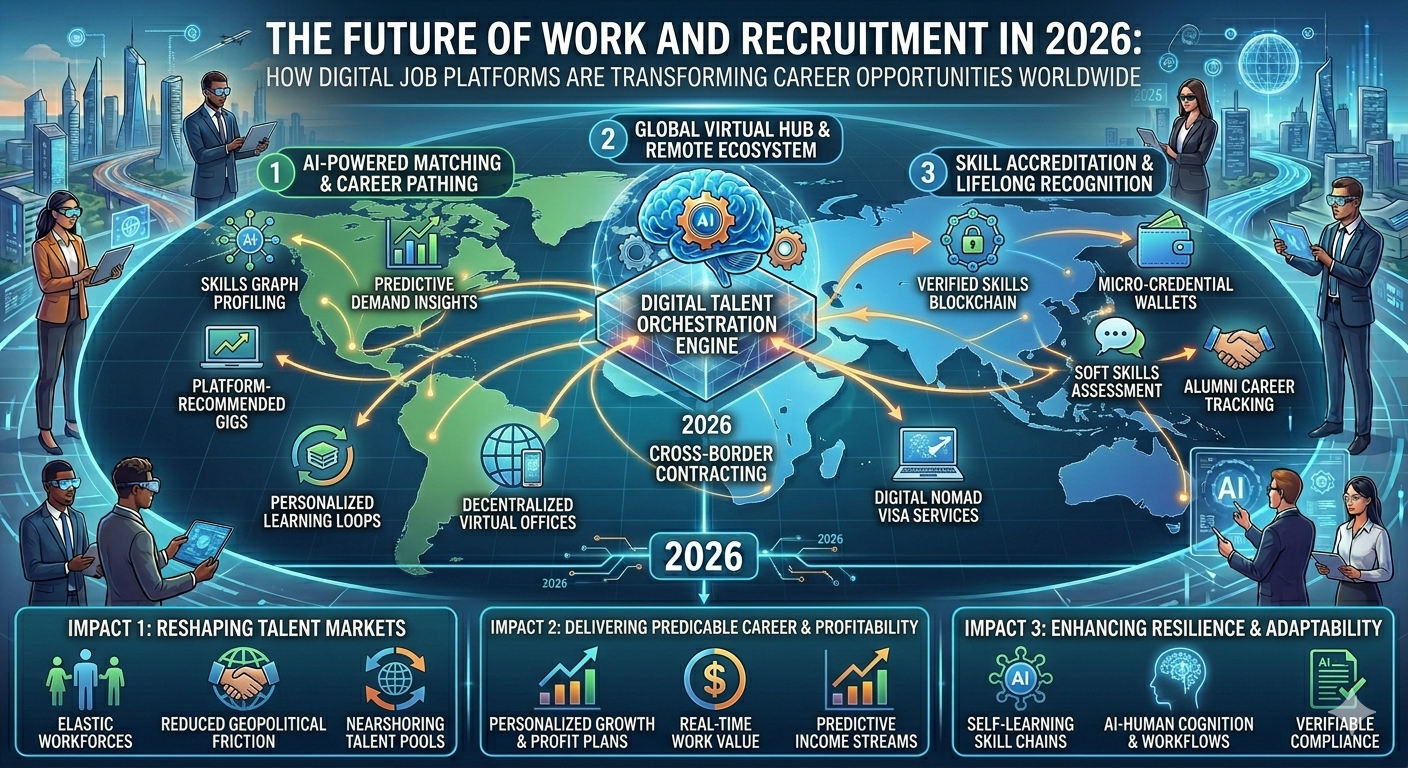
Introduction: A New Era of Employment Has Begun
The global job market is undergoing one of the most significant transformations in modern history. Traditional recruitment models, once dependent on walk-ins, newspaper listings, and manual HR processes, are rapidly being replaced by digital ecosystems that connect employers and candidates in real time.
In 2026, job platforms are no longer just listing boards. They are becoming intelligent career ecosystems that match talent with opportunity using data, automation, and structured hiring systems.
For job seekers, this means faster access to relevant opportunities. For employers, it means reduced hiring time, better candidate quality, and improved workforce alignment.
Platforms like modern job portals are now at the center of this transformation, acting as bridges between talent and global employers.
1. The Evolution of Job Searching: From Manual to Digital Systems
Historically, job searching was a slow and uncertain process. Candidates relied on:
- Newspaper advertisements
- Physical CV submissions
- Recruitment agencies with limited reach
- Word-of-mouth recommendations
This process lacked speed, transparency, and scalability.
Today, the system has evolved into a fully digital hiring ecosystem, where:
- Job postings are updated in real time
- Candidates can apply instantly
- Employers can filter applicants based on skills and experience
- Data-driven matching improves hiring accuracy
This shift has made recruitment more efficient, but also more competitive.
2. Why Traditional Hiring Models Are Becoming Obsolete
Traditional recruitment methods face several limitations:
2.1 Slow Hiring Cycles
Manual screening and offline processes delay hiring decisions.
2.2 Limited Candidate Reach
Employers only access local or network-based talent pools.
2.3 High Recruitment Costs
Agency fees and manual HR processes increase expenses.
2.4 Poor Candidate Matching
Without data systems, hiring decisions often rely on intuition rather than analytics.
These limitations make traditional systems unsuitable for modern workforce demands.
3. The Rise of Digital Job Platforms
Digital job platforms have transformed hiring into a structured, scalable system.
Modern platforms allow:
- Instant job posting
- Global candidate access
- Automated filtering systems
- Real-time application tracking
- AI-driven matching mechanisms
This has created a shift from reactive hiring to proactive talent acquisition.
Instead of waiting for candidates, employers now actively attract and filter talent through structured digital systems.
4. How Modern Job Portals Work
A modern job platform operates as a multi-layer ecosystem:
4.1 Job Listing Layer
Employers post job opportunities with detailed descriptions, salary ranges, and requirements.
4.2 Candidate Layer
Job seekers create profiles, upload CVs, and apply to relevant roles.
4.3 Matching System
Algorithms or structured filters match candidates with suitable job openings.
4.4 Communication Layer
Employers and candidates interact through messaging systems or application tracking tools.
4.5 Analytics Layer
Platforms track application performance, hiring success rates, and user engagement.
This creates a closed-loop recruitment system that improves over time.
5. The Role of Data in Modern Recruitment
Data is now the foundation of hiring efficiency.
Modern job platforms analyze:
- Candidate skill distribution
- Application success rates
- Job market demand trends
- Salary benchmarks
- Hiring time cycles
This data allows employers to make informed decisions and refine their hiring strategies.
For example:
- If a job receives too many irrelevant applications → filters are adjusted
- If a role takes too long to fill → salary or requirements are optimized
- If certain skills are in demand → employers adjust job descriptions
Recruitment is no longer guesswork—it is data-driven decision-making.
6. The Importance of Candidate Experience
In 2026, candidate experience is a critical factor in recruitment success.
A poor experience leads to:
- Drop-offs during application
- Reduced platform trust
- Lower engagement rates
A strong experience includes:
- Simple application processes
- Clear job descriptions
- Fast response times
- Transparent hiring stages
Modern job platforms focus heavily on improving usability and reducing friction in the hiring journey.
7. Employer Benefits of Digital Job Platforms
For employers, digital hiring systems provide significant advantages:
7.1 Faster Hiring
Automation reduces time-to-hire significantly.
7.2 Better Candidate Quality
Filtering systems ensure only relevant candidates apply.
7.3 Cost Efficiency
Reduced reliance on external recruitment agencies lowers costs.
7.4 Global Reach
Employers can access talent beyond geographical boundaries.
7.5 Scalable Hiring Systems
Companies can hire multiple roles simultaneously with structured workflows.
8. The Changing Role of Job Seekers
Job seekers today must adapt to a more competitive and digital environment.
Key expectations include:
8.1 Skill-Based Hiring
Employers focus more on skills than degrees alone.
8.2 Online Presence
Digital CVs and profiles are now essential.
8.3 Continuous Learning
Candidates must continuously upgrade skills to stay relevant.
8.4 Faster Application Cycles
Opportunities move quickly, requiring fast decision-making.
The modern job seeker is no longer passive—they are active participants in a competitive ecosystem.
9. Industry Trends Shaping the Future of Recruitment
Several key trends are shaping the future job market:
9.1 AI-Based Recruitment
Artificial intelligence is increasingly used to match candidates with roles based on skills and behavior patterns.
9.2 Remote and Hybrid Work
Companies are expanding hiring beyond physical office locations.
9.3 Skills-Based Hiring
Employers are prioritizing real-world skills over formal education.
9.4 Automation in HR Processes
From CV screening to interview scheduling, automation is reducing manual workload.
9.5 Gig Economy Expansion
Freelance and contract-based roles are becoming more common.
10. Challenges in the Modern Job Market
Despite advancements, challenges remain:
10.1 Job Market Saturation
High competition increases difficulty in securing roles.
10.2 Skill Mismatch
Many candidates do not meet evolving industry requirements.
10.3 Fake or Low-Quality Listings
Some platforms struggle with maintaining job authenticity.
10.4 Rapid Technological Change
Skills become outdated faster than before.
Addressing these challenges requires continuous improvement in both platform systems and candidate development.
11. The Future of Recruitment Platforms
The future of job platforms is moving toward fully integrated career ecosystems.
Expected developments include:
- Predictive hiring models
- AI-driven career recommendations
- Automated skill gap analysis
- Real-time employer-candidate interaction
- Fully personalized job dashboards
These systems will not only help users find jobs but also guide long-term career growth.
Conclusion: The Digital Job Revolution Is Here
The recruitment industry is no longer operating within traditional boundaries. It has evolved into a dynamic, data-driven ecosystem that connects global talent with opportunities in real time.
For job seekers, this means faster access to better opportunities. For employers, it means smarter hiring decisions and improved workforce quality.
Digital job platforms are now central to this transformation, acting as the backbone of modern employment systems.
In 2026 and beyond, success in the job market will depend not just on finding opportunities—but on how effectively individuals and organizations adapt to intelligent, automated, and data-driven recruitment systems.