

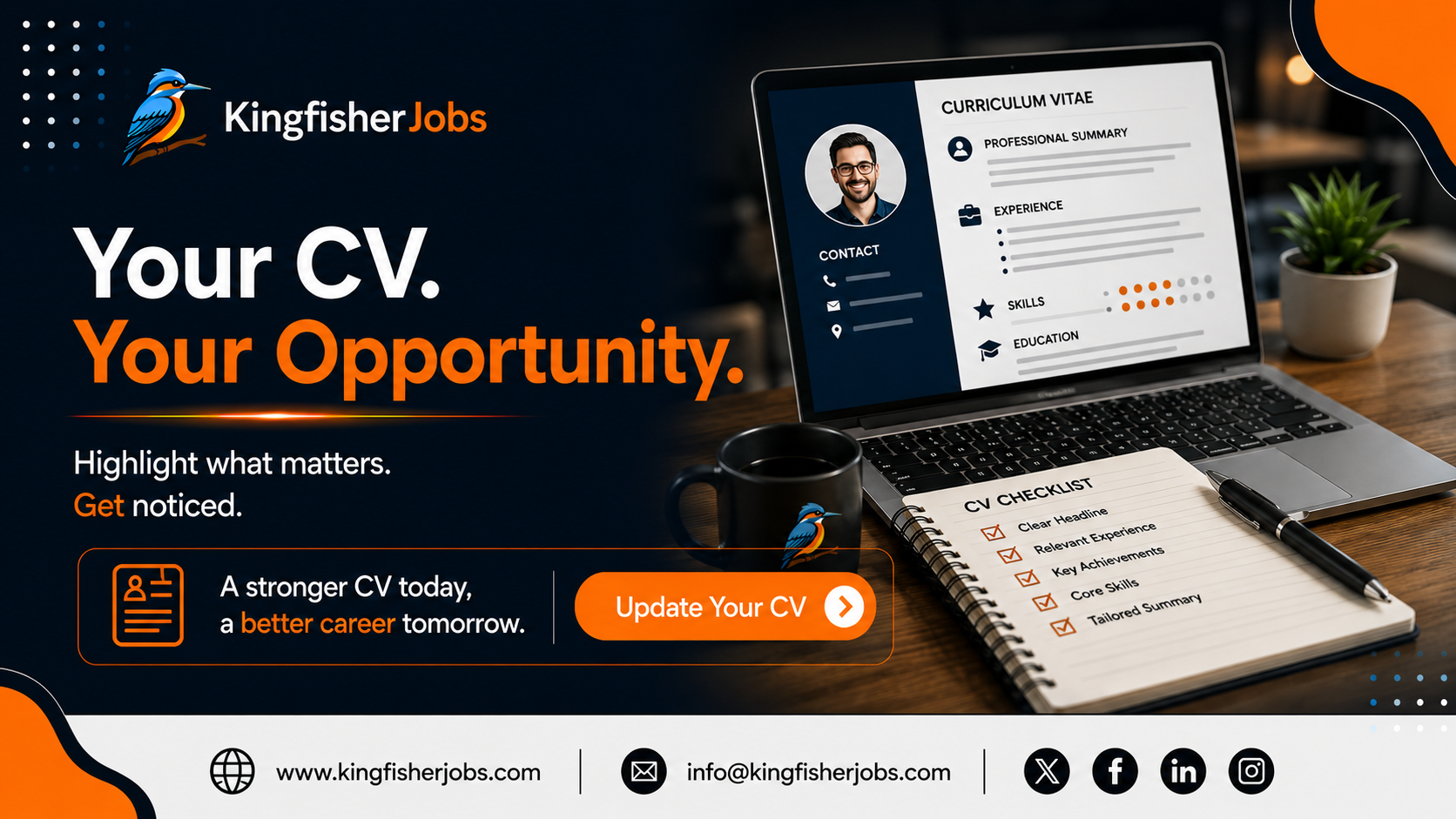
Your CV is often the first impression an employer has of you. A stronger CV makes your experience easier to understand, highlights the skills that matter and gives recruiters a clearer reason to move your application forward. The goal is simple: present your value clearly and make every important detail count.
Why Your CV Matters
A CV is more than a record of where you have worked. It is a professional marketing document designed to show employers why your background may be relevant to their opportunity.
Recruiters and hiring managers may review many applications for the same role, which means your CV needs to communicate important information quickly.
If your strongest skills, experience and achievements are difficult to identify, a good candidate can easily be overlooked.
Your CV. Your Opportunity.
A stronger CV helps employers understand what you can do, what you have achieved and why you may be the right person for the role.
Start With a Clear CV Structure
A professional CV should be easy to scan. Employers should be able to locate your experience, skills and qualifications without searching through complicated layouts.
A strong CV structure usually includes:
- Contact details.
- A professional summary or profile.
- Key skills.
- Work experience.
- Relevant achievements.
- Education and qualifications.
- Professional certifications where relevant.
- Additional information that supports the role.
The exact order may vary depending on your experience, but the most relevant information should always be easy to find.
Write a Strong Professional Summary
The professional summary near the top of your CV is one of the first sections an employer may read.
Avoid generic statements such as:
“I am a hardworking individual looking for a challenging role where I can grow.”
Instead, give the employer useful professional information:
“Digital marketing professional with five years of experience across SEO, paid campaigns and content strategy, with a strong record of improving lead generation and online visibility for growing businesses.”
A strong summary should quickly explain your professional level, relevant expertise and the type of value you can bring.
Highlight What Matters Most
Your CV does not need to give equal space to every job or responsibility you have ever had.
The most relevant information should receive the greatest attention.
Prioritise:
- Experience related directly to the role.
- Skills mentioned in the job description.
- Achievements that demonstrate results.
- Relevant software or technical knowledge.
- Professional qualifications.
- Leadership or management responsibilities where appropriate.
A good CV is not about including everything. It is about making the most relevant information impossible to miss.
Tailor Your CV for the Opportunity
Sending exactly the same CV to every employer can reduce your chances of standing out.
Tailoring your CV does not mean inventing experience or rewriting everything for each application. It means adjusting the emphasis so your most relevant experience is clearly connected to the vacancy.
Before applying:
- Read the job description carefully.
- Identify the main responsibilities.
- Highlight the skills the employer repeatedly mentions.
- Compare those requirements with your own experience.
- Move relevant skills and achievements higher in your CV.
- Remove or reduce unnecessary detail that distracts from the role.
Skills Need Evidence
A long skills list is easy to create. Evidence is what makes those skills credible.
If you say you are good at leadership, project management or customer service, support that claim elsewhere in your CV.
| Skill | Weak Presentation | Stronger Presentation |
|---|---|---|
| Leadership | Strong leadership skills | Led a team of eight through a major service improvement project. |
| Sales | Good at sales | Exceeded quarterly sales target by 18%. |
| Customer Service | Excellent customer service | Managed complex customer enquiries while maintaining high satisfaction levels. |
| Process Improvement | Process improvement experience | Introduced a new workflow that reduced administration time across the team. |
Turn Responsibilities Into Achievements
Job responsibilities explain what you were expected to do. Achievements explain what changed because you did it well.
Compare:
Responsibility: Responsible for managing social media accounts.
Achievement: Managed social media campaigns across four platforms and increased average audience engagement through a more consistent content strategy.
Employers are usually more interested in results than a simple list of tasks.
Think about whether you have:
- Increased revenue.
- Reduced costs.
- Improved customer satisfaction.
- Delivered projects successfully.
- Improved efficiency.
- Exceeded targets.
- Introduced a new process.
- Managed important clients.
- Supported team growth.
- Solved a difficult business problem.
Show Impact, Not Just Activity.
Results help employers understand how your experience could create value in their organisation.
Use Numbers When They Add Meaning
Numbers can make achievements more specific and credible.
You do not need a percentage or financial figure for every bullet point, but measurable context can strengthen your CV where accurate figures are available.
Useful metrics might include:
- Team size.
- Revenue managed.
- Sales growth.
- Number of customers.
- Project budgets.
- Cost savings.
- Time saved.
- Conversion improvements.
- Targets exceeded.
Always use accurate figures rather than adding numbers simply to make the CV look stronger.
Keep Your Work Experience Easy to Follow
Employers should be able to understand your career history quickly.
For each relevant position, clearly show:
- Job title.
- Company name.
- Employment dates.
- A brief description where useful.
- Key responsibilities.
- Important achievements.
Your most recent and relevant roles will usually need more detail than older positions.
Choose Strong Action Words
The language of your CV can make your contribution clearer.
Instead of repeating phrases such as “responsible for,” use direct action words where they accurately describe your work.
Led
Delivered
Improved
Developed
Managed
Implemented
Include Education Without Letting It Take Over
Your education section should support your application without distracting from stronger professional experience.
If you are early in your career, education may deserve greater prominence. As you gain more relevant work experience, employers may focus increasingly on your professional achievements.
You may include:
- Degree or qualification.
- Institution.
- Dates where appropriate.
- Relevant modules for early-career candidates.
- Professional certifications.
- Relevant specialist training.
What About Career Gaps?
A career gap does not automatically make a CV weak.
People take time away from employment for many reasons, including caring responsibilities, study, travel, health, redundancy or career changes.
You do not need to provide unnecessary personal details. Where helpful, a brief and clear explanation can prevent employers from having to guess.
Clarity is usually stronger than trying to hide an obvious gap in your employment timeline.
Career Changers Should Focus on Transferable Skills
If you are changing industry or job function, your previous job titles may not immediately show why you are relevant.
Your CV needs to make the connection clearer.
Transferable skills might include:
- Communication.
- Customer management.
- Leadership.
- Project coordination.
- Problem-solving.
- Planning and organisation.
- Commercial awareness.
- Data analysis.
- Sales or negotiation.
Use your profile and achievements to explain how those abilities translate into your target career.
Keep the Design Professional
Your CV should look organised and professional, but design should never make the content harder to understand.
Good formatting usually means:
- Readable fonts.
- Clear headings.
- Consistent spacing.
- Short paragraphs.
- Well-structured bullet points.
- Consistent dates.
- Enough white space to keep the document readable.
Unless a creative role specifically requires it, unnecessary graphics or overly complicated layouts may distract from the information employers actually need.
Proofread Every Detail
A strong CV can lose credibility because of avoidable mistakes.
Before applying, check:
- ☑ Spelling and grammar.
- ☑ Phone number.
- ☑ Email address.
- ☑ Employment dates.
- ☑ Job titles.
- ☑ Company names.
- ☑ Formatting consistency.
- ☑ Unexplained abbreviations.
- ☑ Repeated words or sentences.
- ☑ File name.
Reading the document aloud or asking someone else to review it can help catch mistakes you have stopped noticing.
Update Your CV Regularly
Many people update their CV only after discovering a role they want to apply for.
This often means trying to remember achievements from months or years earlier.
Keeping your CV updated makes future applications faster and more accurate.
Update it when you:
- Complete a major project.
- Receive a promotion.
- Gain a qualification.
- Learn an important new skill.
- Take on new responsibilities.
- Achieve a significant business result.
A Stronger CV Today. A Better Career Tomorrow.
Recording achievements while they are fresh makes it easier to build strong applications when the right opportunity appears.
Common CV Mistakes to Avoid
| Common Mistake | Better Approach |
|---|---|
| Using the same CV for every application | Tailor important sections to the vacancy. |
| Listing responsibilities only | Add achievements and outcomes. |
| Using a generic opening profile | Explain your professional value clearly. |
| Adding irrelevant information | Prioritise information that supports the role. |
| Using complicated formatting | Keep the document clean and easy to scan. |
| Forgetting to proofread | Complete a final accuracy check before sending. |
Your Final CV Checklist
- ☑ Is the professional summary clear?
- ☑ Are the most relevant skills easy to identify?
- ☑ Have you included achievements as well as responsibilities?
- ☑ Is your work history easy to follow?
- ☑ Is the CV tailored to the opportunity?
- ☑ Are important qualifications included?
- ☑ Is the design clean and readable?
- ☑ Is every detail accurate?
- ☑ Have you proofread the final version?
- ☑ Is the file professionally named?
Your CV Should Grow With Your Career
Your career changes over time, and your CV should change with it.
Early in your career, education and entry-level experience may receive greater attention. Later, leadership, specialist expertise and measurable results may become much more important.
Continually review whether your CV represents the professional you are today rather than the person you were several years ago.
The objective is not simply to document the past. Your CV should help create the next opportunity.
Find Your Next Opportunity with KingfisherJobs
A strong CV is most valuable when it is connected with the right opportunity.
KingfisherJobs helps job seekers explore vacancies and connect with employers looking for people with the right skills, experience and ambition.
Whether you are preparing for your first professional role, planning a career change or looking for your next step, improving your CV can give you a stronger foundation for every application that follows.
Update Your CV. Explore Your Next Opportunity.
Highlight what matters, communicate your value and discover career opportunities with KingfisherJobs.
Website: www.kingfisherjobs.com | Email: info@kingfisherjobs.com
Frequently Asked Questions
How long should my CV be?
There is no perfect length for every candidate. Focus on relevance and readability. Include enough information to demonstrate your suitability without filling the document with unnecessary detail.
Should I use the same CV for every job?
It is better to tailor important sections such as your summary, key skills and relevant achievements so they connect clearly with the specific vacancy.
Should my CV include a photo?
Requirements and conventions vary by country and industry. Follow local expectations and any instructions provided by the employer.
Should I include every job I have ever had?
Not necessarily. Prioritise recent and relevant experience. Older or unrelated roles may require less detail, particularly when you already have extensive relevant experience.
What are the most important parts of a CV?
A clear professional summary, relevant skills, well-structured work experience and strong achievements are particularly important because they help employers understand your suitability quickly.
Should I put achievements on my CV?
Yes. Achievements help demonstrate the impact of your work and can make your experience more persuasive than responsibilities alone.
How often should I update my CV?
Update it whenever you gain important skills, qualifications, responsibilities or achievements. Keeping it current makes future applications much easier.