


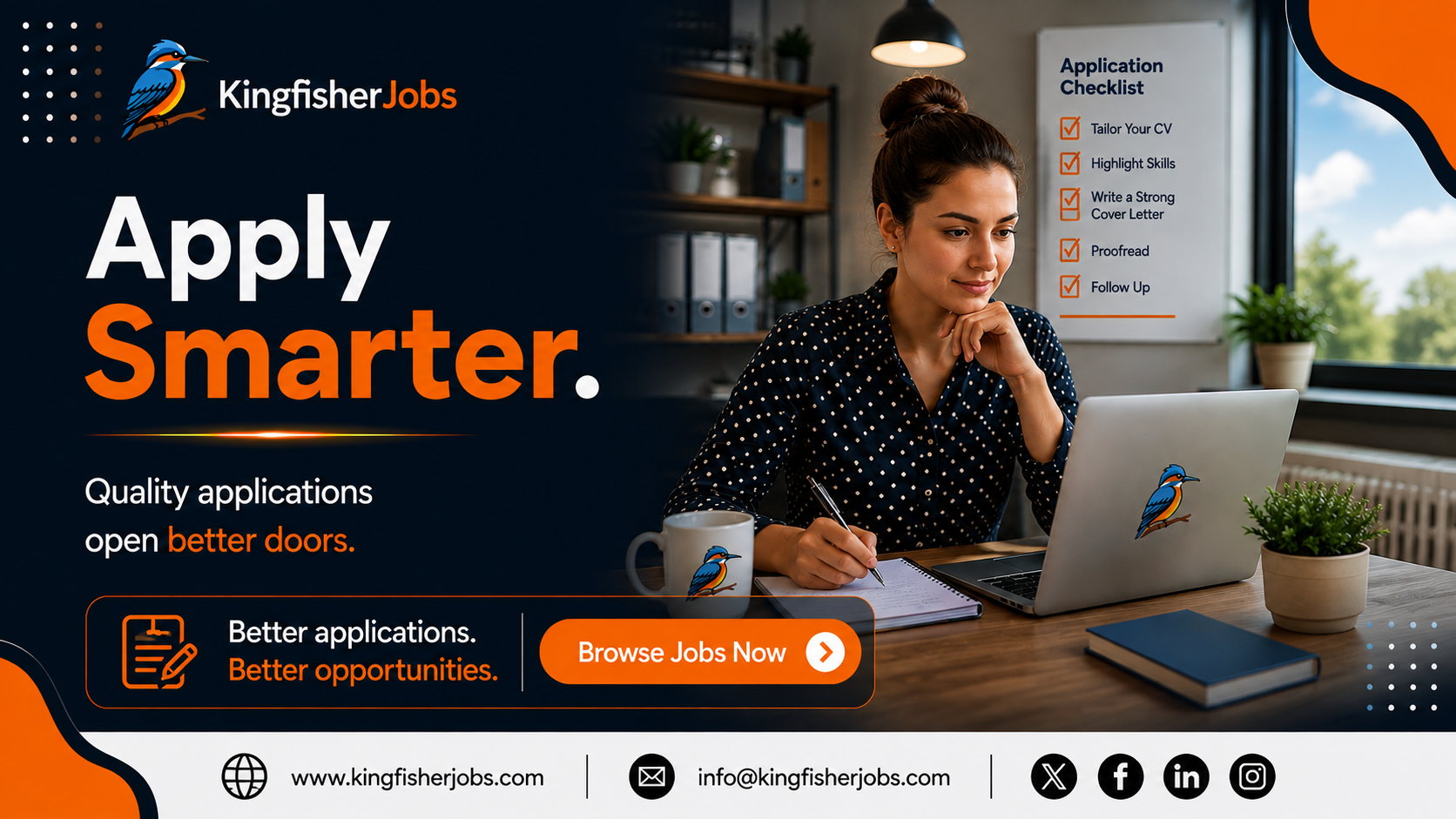
A strong job application is more than sending the same CV to every employer. The best applications are clear, relevant and carefully tailored to the opportunity. When you understand the role, highlight the right skills and present your experience effectively, you give employers a much stronger reason to move your application forward.
Why Better Applications Matter
Applying for jobs can quickly become a numbers game. When candidates are searching actively, it can be tempting to send as many applications as possible and hope that one receives a response.
But quantity does not automatically create opportunity.
A smaller number of relevant, well-prepared applications can often be more effective than dozens of generic submissions. Employers want to understand why your background fits their vacancy, and that connection needs to be clear from the beginning.
Apply Smarter.
Better applications are not simply longer applications. They are more relevant, more focused and easier for employers to understand.
Start by Reading the Job Description Properly
Many applicants begin editing their CV before fully understanding the vacancy.
A better approach starts with the job description. Employers usually reveal the most important requirements through the responsibilities, skills and experience they emphasise.
Look for:
- The main responsibilities of the role.
- Skills mentioned more than once.
- Essential experience.
- Preferred or desirable experience.
- Software, systems or technical requirements.
- Customer, management or commercial responsibilities.
- Any specific qualifications.
- Clues about the company’s priorities.
Once you understand what the employer needs, you can decide which parts of your experience deserve the most attention.
Tailor Your CV to the Role
Your CV should not read like an identical document sent to every company.
Tailoring does not mean rewriting your entire career history for every application. It means adjusting the emphasis so the most relevant information becomes easier to find.
You can tailor your CV by:
- Updating your professional summary.
- Moving the most relevant skills higher.
- Expanding relevant achievements.
- Reducing unnecessary detail from unrelated experience.
- Using terminology that accurately reflects the vacancy.
- Making important qualifications easy to identify.
The employer should be able to look at your CV and quickly understand why your experience is relevant to their vacancy.
Make Your Opening Profile Work Harder
The profile at the top of your CV is valuable space. It should quickly communicate who you are professionally and why you may be relevant to the role.
Avoid vague statements that could describe almost anyone.
Instead of writing:
“I am a hardworking, motivated individual looking for a new opportunity.”
Consider something more specific:
“Customer service professional with five years of experience supporting B2B clients, resolving complex enquiries and maintaining high customer retention across fast-paced service environments.”
The second example gives an employer useful information immediately.
Highlight Skills That Actually Matter
A long skills section can look impressive, but employers are more interested in whether you have the capabilities required for their specific vacancy.
Prioritise relevant skills rather than listing everything you have ever done.
| Skill Type | Examples | How to Strengthen It |
|---|---|---|
| Technical Skills | Software, systems, coding, design tools | Show where and how you used them. |
| Commercial Skills | Sales, negotiation, account management | Connect them to measurable outcomes. |
| People Skills | Leadership, communication, collaboration | Support claims with real examples. |
| Operational Skills | Planning, organisation, process improvement | Show the impact on efficiency or results. |
Focus on Achievements, Not Just Responsibilities
Responsibilities tell an employer what your job involved. Achievements show how well you performed it.
Compare these two statements:
Responsibility: Managed customer enquiries.
Achievement: Managed a high-volume customer enquiry queue while maintaining strong response times and improving customer satisfaction.
Achievements provide context and demonstrate contribution.
Consider achievements such as:
- Revenue generated.
- Targets exceeded.
- Processes improved.
- Costs reduced.
- Projects completed.
- Customer satisfaction improved.
- Team performance strengthened.
- Problems successfully resolved.
Make Your CV Easy to Read
Good content can lose impact if the document is difficult to scan.
A professional CV should have a clear structure that allows recruiters and hiring managers to find important information quickly.
Keep the layout simple:
- Use clear section headings.
- Use consistent fonts and formatting.
- Keep paragraphs short.
- Use bullet points for key responsibilities and achievements.
- Keep dates and job titles consistent.
- Avoid unnecessary graphics that distract from the content.
Clear Beats Complicated.
Your CV should make your experience easier to understand, not make the employer work harder to find it.
Write a Strong Cover Letter When One Is Needed
A cover letter gives you space to explain the connection between your experience and the vacancy in more detail.
It should add context rather than simply repeating your CV.
A useful structure is:
- Opening: State the role you are applying for and why it interests you.
- Relevant experience: Explain how your background matches the key requirements.
- Evidence: Highlight one or two strong examples or achievements.
- Motivation: Explain why the organisation or opportunity appeals to you.
- Closing: End professionally and express interest in discussing the role further.
Avoid Generic Cover Letters
If the same cover letter could be sent to twenty different employers without changing anything, it is probably too generic.
A strong letter should refer to the actual opportunity and show that you understand what the employer is looking for.
Personalisation does not require a long document. A focused letter can often be more effective than a lengthy one.
Use Keywords Naturally
Some employers and recruitment systems may search applications for relevant terminology.
If a job description repeatedly uses accurate terms that genuinely match your experience, including those terms naturally within your CV can make your application clearer.
Do not copy entire sections of a job advert or add keywords for skills you do not possess. The goal is relevance, not manipulation.
Use the employer’s language where it accurately describes your real experience.
Proofread Before You Apply
Small mistakes can reduce the professionalism of an otherwise strong application.
Before submitting, review your CV and cover letter carefully.
Check:
- Spelling and grammar.
- Company name.
- Job title.
- Employment dates.
- Contact information.
- Formatting consistency.
- Attachment names.
- Application instructions.
Reading your application aloud can help you notice awkward wording that is easy to miss when reading silently.
Name Your Files Professionally
Employers may download dozens or hundreds of applications.
A file called CV-FINAL-V7-NEW.pdf is less professional than something clear such as:
Sarah-Khan-CV.pdf
Sarah-Khan-Cover-Letter.pdf
Small details help make the complete application feel more professional.
Follow the Application Instructions
Employers sometimes request specific information, documents or formats.
Ignoring these instructions can create the impression that you did not read the vacancy carefully.
If the employer requests a CV and cover letter, send both. If they ask you to answer application questions, give those questions proper attention rather than treating them as a formality.
Apply for Roles That Actually Fit
You do not need to match every single line of a job description before applying.
Many vacancies contain a mixture of essential and desirable requirements. If you meet the core requirements and can demonstrate transferable skills, the opportunity may still be appropriate.
At the same time, applying to roles that are completely unrelated to your experience can consume time that could be spent improving stronger applications.
| Apply When… | Think Carefully When… |
|---|---|
| You meet most core requirements. | You lack several essential requirements. |
| Your experience is directly relevant. | The role is completely outside your background. |
| You have transferable skills. | You cannot explain why your skills transfer. |
| The opportunity supports your goals. | You are applying only to increase the application count. |
Keep Track of Your Applications
Once you begin applying to several roles, it becomes easy to forget which CV version you submitted or when an application was completed.
Keeping a simple application tracker can make your job search more organised.
Record:
- Company name.
- Job title.
- Date applied.
- Closing date.
- Salary where listed.
- CV version used.
- Contact details.
- Interview dates.
- Follow-up status.
This becomes particularly useful when an employer contacts you several weeks after you originally applied.
Follow Up Professionally
In some situations, a brief professional follow-up can demonstrate continued interest.
Timing matters. Avoid contacting an employer repeatedly or immediately after submitting the application.
If the closing date has passed and no timeline was provided, a short enquiry about the status of the recruitment process may be reasonable.
Professional Follow-Up
Keep it short, polite and focused on your continued interest rather than demanding an immediate response.
Learn From Rejections
Not every strong application will result in an interview.
Recruitment decisions can depend on many factors, including candidate numbers, internal applicants, specific experience and changing business requirements.
Instead of treating every rejection as evidence that your application is poor, look for patterns.
Ask yourself:
- Am I applying to relevant roles?
- Does my CV clearly show the required experience?
- Am I highlighting achievements strongly enough?
- Does my opening profile match my target roles?
- Could my applications be more tailored?
- Are there skills I need to develop?
If you submit many relevant applications without reaching interview stage, your application materials may need improvement.
Quality vs Quantity in Job Applications
There is no perfect number of jobs to apply for each week.
The right balance depends on your profession, experience and the number of suitable vacancies available.
What matters is avoiding two extremes: spending hours perfecting one application while missing other suitable opportunities, or applying so quickly that nothing is tailored.
Quantity Only
Many applications, limited relevance and minimal tailoring.
Smarter Approach
Relevant opportunities, focused tailoring and consistent application activity.
Your Smart Application Checklist
- ☑ Read the complete job description.
- ☑ Research the employer.
- ☑ Tailor your CV.
- ☑ Highlight relevant skills.
- ☑ Include strong achievements.
- ☑ Write a focused cover letter if required.
- ☑ Check application instructions.
- ☑ Proofread everything.
- ☑ Name attachments professionally.
- ☑ Record the application in your tracker.
- ☑ Prepare for a possible interview.
- ☑ Follow up professionally where appropriate.
Better Applications Create Better Opportunities
Job searching can be competitive, but candidates have more control over application quality than they sometimes realise.
You cannot control who else applies or exactly how an employer makes the final decision. You can control how clearly you communicate your experience.
Tailoring your CV, highlighting relevant skills, using real achievements and proofreading carefully can help employers understand your potential more quickly.
The objective is not to make yourself look perfect for every vacancy. It is to make the strongest honest case for why you fit the opportunities that genuinely match your background.
Better Applications. Better Opportunities.
Take a little more time to make every application relevant, clear and professional.
Find Your Next Opportunity with KingfisherJobs
A smarter application begins with finding a role that genuinely matches your skills and ambitions.
KingfisherJobs helps job seekers discover vacancies and connect with employers searching for talent.
Whether you are beginning your career, returning to work or looking for your next professional move, approaching each opportunity with a focused application can help you present your experience with greater confidence.
Ready to Apply Smarter?
Browse opportunities with KingfisherJobs, find roles that fit your experience and give every strong application the attention it deserves.
Website: www.kingfisherjobs.com | Email: info@kingfisherjobs.com
Frequently Asked Questions
Should I tailor my CV for every application?
You do not need to rewrite the entire document each time, but adjusting your profile, key skills and relevant experience can help make the connection with the role much clearer.
How long should a CV be?
Length depends on your experience, but clarity and relevance matter more than adding unnecessary detail. Include enough information to demonstrate your suitability without allowing less relevant content to dominate the document.
Do I need a cover letter for every job?
Follow the employer’s instructions. If a cover letter is requested, provide one. Even when optional, it can be useful when you need to explain motivation, transferable skills or circumstances that are not obvious from your CV.
How many jobs should I apply for?
There is no ideal number. Focus on maintaining consistent activity while making sure the opportunities are relevant and your applications remain high quality.
Should I apply if I do not meet every requirement?
If you meet the core requirements and can demonstrate relevant transferable skills, applying may still be worthwhile. Distinguish between essential requirements and preferences.
Should I follow up after submitting an application?
A short professional follow-up can sometimes be appropriate, particularly after the closing date. Avoid contacting the employer repeatedly or too soon after submitting.
Why am I applying but not getting interviews?
Review whether you are targeting relevant roles and whether your CV clearly demonstrates the required experience. Improving tailoring, achievements, clarity and presentation may help strengthen future applications.