

Introduction — Why Today’s Job Market Demands a Strategic Approach
The job market in 2026 is fast, data‑driven, and intensely competitive.
Gone are the days when:
- Sending 20+ resumes guarantees interviews
- Job posting alone fills positions
- Experience alone lands the role
Today’s job ecosystem is shaped by:
- Digital hiring platforms
- Employer branding
- Skills‑based evaluation
- Candidate experience expectations
- Speed of response and engagement
As a candidate, you must navigate constantly evolving expectations.
As an employer, you must attract, evaluate, and hire talent in a competitive pool.
Success is no longer about effort, it’s about strategy.
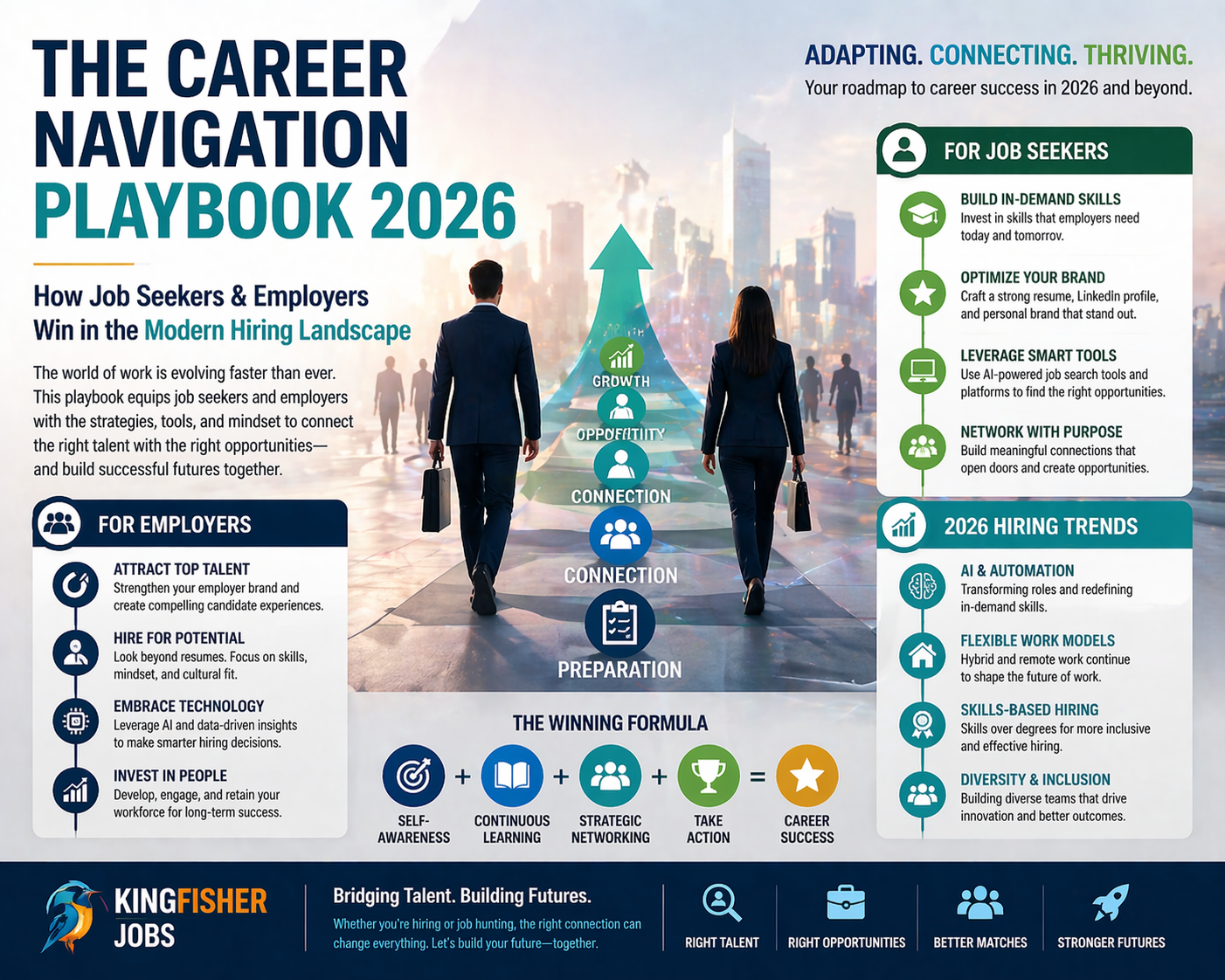
This playbook shows job seekers and employers how to succeed in the 2026 hiring environment — with systems, not guesswork.
Part I — The Modern Hiring Landscape: What’s Changed
1. Digital Platforms Rule the Process
Platforms like KingfisherJobs don’t just list opportunities — they match skills, preferences, and intent to create better fits for both candidates and employers.
Algorithms now drive:
- Intelligent job recommendations
- Skill filtering
- Candidate prioritization
- Employer matching efficiencies
These systems reduce friction — but also raise competition.
Merely being qualified is not enough; being discoverable, relevant, and compelling is critical.
2. Skills Over Titles
Employers care about what you can do, not just what your title says.
Skills are now:
- Trackable
- Comparable
- Standardized
Platforms allow candidates to highlight specific competencies that matter more than generic job titles.
For employers, skills make screening more accurate and outcomes more predictable.
3. Speed and Experience of Hiring
Data shows that top candidates accept new roles within days — not weeks.
Slow hiring processes lose talent.
A fast, clear, communicative process is now a competitive advantage for employers.
Part II — The Candidate Play: Landing Better Jobs Faster
To succeed as a candidate in 2026, you need a systematic approach, not random applications.
This section gives a complete candidate playbook.
Step 1: Clarify Your Career Vision
Too many candidates search without purpose.
Before job hunting, answer:
- What roles am I truly targeting?
- What skills define my value proposition?
- What industries interest me?
- What work culture fits me best?
Clarity helps you search intelligently, not aimlessly.
Step 2: Build a Skills‑Centric Profile
Recruiters and AI systems look for signal words that match job requirements.
Your profile should include:
- Core competencies listed as skills
- Certifications and tools used
- Projects, measurable outcomes, achievements
- Keywords from job descriptions
Example:
Instead of:
“Managed marketing campaigns”
Use:
“Digital marketing campaigns — SEO, Google Ads, ROI optimization (20%+ increase)”
This increases automated matching accuracy.
Step 3: Targeted Search Instead of Scattershot Applications
Don’t apply to everything you see.
Instead:
- Use filters to narrow roles (location, experience level, salary range)
- Read job descriptions fully
- Note recurring skill requirements
- Tailor application to the employer’s language
A tailored application converts far better than a generic one.
Step 4: Write Compelling Applications
Your application must:
- Address the employer’s key needs
- Highlight measurable results
- Show clear alignment to the job
Use outcome metrics:
Example:
“Increased sales conversions by 30% through targeted email automation.”
Numbers speak louder than adjectives.
Step 5: Prepare for Interview Success
Preparation is not optional — it’s strategic.
Great preparation includes:
- Researching the company culture
- Understanding the role expectations
- Preparing STAR (Situation, Task, Action, Result) stories
- Asking insightful questions
Confidence in interviews comes from prepared mastery, not guesswork.
Step 6: Manage Your Candidate Experience
Follow‑ups matter.
After interviews:
- Send thank‑you messages
- Clarify next steps
- Share additional portfolio samples if relevant
Candidates who manage communication professionally stand out.
Step 7: Accept Offers Strategically
When offers come:
- Evaluate total compensation (salary, bonus, benefits)
- Consider career progression
- Analyze culture and fit
- Compare offers (if multiple exist)
Acceptance is a negotiation phase — not just an acceptance phase.
Part III — The Employer Play: Hiring Smarter, Not Harder
Employers today face the other side of the equation — how to secure and retain top talent faster than competitors.
Step 1: Define Hiring Needs With Clarity
Bad hires start with unclear expectations.
Write job descriptions that include:
- Essential skills required
- Success metrics for the role
- Experience range
- Salary band
- Culture alignment markers
This improves candidate quality at the outset.
Step 2: Leverage Platform Matching Tools
Job boards with matching algorithms — like KingfisherJobs — do more than display listings.
Use:
- Skills matching insights
- Candidate signal metrics
- Preference and intent filters
This reduces noise and improves relevance.
Step 3: Streamline Screening
Create a structured screening pipeline:
- Resume review (skills alignment)
- Short introductory call
- Skills assessment or case work
- Structured interviews
A structured pipeline reduces bias and decision lag.
Step 4: Frequency and Predictability of Communication
Candidates today judge employers by their communication quality.
Communicate:
- Expected timeline
- Screening status
- Next steps clearly
Poor communication leads to candidate drop‑off.
Step 5: Use Data to Improve Hiring Decisions
Track metrics like:
- Time‑to‑hire
- Quality of hire
- Offer acceptance rate
- Candidate satisfaction score
These metrics help refine pipelines for future success.
Step 6: Build a Talent Brand
Today’s top candidates research companies before applying.
Invest in:
- Clear employer profiles
- Employee‑generated content
- Success stories and testimonials
A strong talent brand attracts applicants with intent rather than passive browsing.
Part IV — The Co‑Created Future: Candidates and Employers Win Together
The most successful hiring outcomes occur when both sides act strategically.
Consider:
- Candidates choose roles with long‑term fit
- Employers choose candidates with measurable capability
This alignment improves retention and business outcomes.
Part V — Skills That Matter Most in 2026
Whether you are a candidate planning your career or an employer hiring for success, these skill areas dominate job outcomes:
- Digital literacy and automation tools
- Data interpretation and analytics
- Communication and collaboration
- Problem solving under ambiguity
- Continuous learning mindset
Jobs are fluid — skills define mobility.
Part VI — Common Mistakes and How to Avoid Them
Mistake 1 — Applying Blindly
Solution: Target jobs with focus, not volume.
Mistake 2 — Generic Applications
Solution: Tailor every application with measurable outcomes.
Mistake 3 — Slow Hiring Response
Solution: Streamline communication and decisions.
Mistake 4 — Ignoring Cultural Fit
Solution: Match skills and values.
Part VII — Real‑World Success Stories
Story 1 — From Frustration to Dream Role
A candidate applied strategically with tailored applications focused on measurable results and secured multiple offers within weeks.
Key factor: Intentional alignment between skills and job requirements.
Story 2 — From Long Hiring Cycles to High‑Quality Talent
An employer redesigned hiring steps with structured screening, resulting in a 60% reduction in time‑to‑hire and improved retention.
Key factor: Predictable process and communication.
Part VIII — Future Hiring Trends to Watch in 2026
1. AI‑Augmented Job Matching
Algorithms will continue shaping opportunities and matching accuracy.
2. Skills‑Centric Hiring
Skills and outcomes will outweigh degrees in many domains.
3. Remote and Hybrid Work Permanence
Geographic constraints will continue loosening — expanding opportunity pools.
4. Predictive Candidate Analytics
Platforms will provide insights into candidate fit scores, engagement likelihood, and retention potential.
Conclusion — Strategy Wins the Hiring Game
Success in the modern job market is no accident.
It’s a result of intentional strategy:
- Clear goals
- Structured processes
- Measure‑driven execution
- Communication that builds confidence
Whether you’re a job seeker or an employer, applying a systematic approach creates better outcomes in less time.
Call to Action
For candidates:
Start by defining your career goals and building a skills‑centric profile today on KingfisherJobs.
For employers:
Refine your hiring pipeline with clear role expectations and leverage platform insights